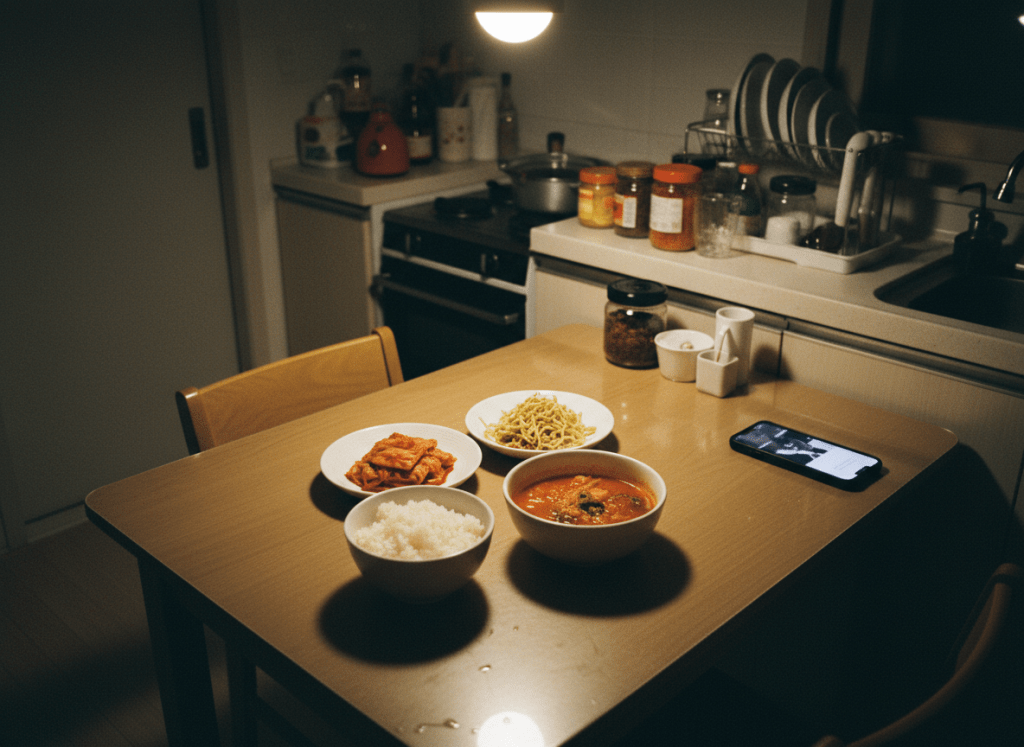
The phrase is often translated as Korea’s version of “How are you?” That is useful—and incomplete.
By KSPILL Editorial
A Korean friend texts you at 10:37 p.m.:
밥 먹었어?
The direct translation is “Have you eaten?” But there is no dinner plan, and they do not ask what you ate. Were they really asking about food?
Possibly.
They may also be checking whether you are taking care of yourself, opening a conversation, or quietly showing that you were on their mind.
The usual explanation online is that 밥 먹었어? (bap meogeosseo?) is simply Korea’s version of “How are you?” That comparison is useful, but it removes the most important part: unlike a purely formulaic greeting, the Korean question often keeps its literal meaning.
Who asks, when they ask, how close you are, and what they say next can all change what the question is doing.
It Is a Greeting—and Still a Real Question
Korean pragmatics research does not treat “bap greetings” as one fixed cultural code.
A 2014 study divided them into questions and meal suggestions. Among acquaintances, the question can express positive interest. Between close people, it can signal concern for the other person’s well-being. A meal suggestion can open a relationship, deepen it, maintain closeness, or help repair distance.
A separate 2017 study surveyed 144 native Korean speakers in their 20s. It found that expressions such as 밥 먹었어? do function as greetings, but still retain a genuine interrogative function. Many respondents answered honestly, while their relationship with the speaker and the circumstances of the conversation affected how they understood the question.
So there is no universal hidden translation.
“Have you eaten?” may mean:
- Did you actually eat?
- Are you doing okay?
- Have you been taking care of yourself?
- Do you want to eat with me?
- I wanted a reason to talk to you.
Sometimes it does more than one of these jobs at once.
What Does Bap Actually Mean?
밥 (bap) can mean cooked rice, but it also refers more broadly to food eaten as a meal.
That is why someone can say 밥 먹자—“Let’s eat”—even when the plan is noodles, pizza, or sandwiches. The National Institute of Korean Language defines bap in this broader meal sense and identifies 진지 (jinji) as its honorific equivalent.
The wording also changes with the relationship:
| Korean | Natural meaning | Typical use |
|---|---|---|
| 밥 먹었어? | Have you eaten? | Casual; close friends, siblings, partners, or someone younger |
| 밥 먹었어요? | Have you eaten? | Polite and familiar |
| 식사하셨어요? | Have you had a meal? | More respectful or formal |
| 진지 드셨어요? | Have you eaten? | Honorific, often addressed to an older family member |
Official Korean language research lists questions such as 식사하셨어요? and 밥 먹었어? among greetings used around mealtimes.
That timing matters. A question at 12:30 p.m. is more likely to be connected to an actual lunch than the same message late at night.
The Postwar Explanation Is Not Entirely Wrong—Just Incomplete
A popular story says Koreans began asking “Have you eaten?” after the Korean War because food was scarce.
The hardship is real. National Archives records show that average annual rice production from 1953 to 1955 remained below the level recorded during the colonial period, while restoring food production was a major public concern.
But the claim that one war created the expression is too neat.
Korean cultural reference materials describe meal-status questions as part of established greeting customs, including forms equivalent to “Have you eaten?” after the morning meal. That makes it difficult to give the expression one modern starting point.
The more defensible conclusion is this:
Repeated periods of food insecurity likely strengthened the link between eating and being safe or well, but they do not fully explain when or why the greeting first appeared.
Meals were also a practical measure of everyday welfare. Asking whether someone had eaten was a concrete way to ask whether basic life was in order.
This distinction matters. History should add context, not become a tidy origin myth.
Why a Meal Question Can Feel More Personal Than “How Are You?”
A broad emotional question can feel heavy. A food question is easier to answer.
“Are you okay?” may invite a serious conversation. “Did you eat?” gives the other person choices. They can answer with one word, explain that they were too busy, mention a difficult day, or turn the question into a plan to meet.
The care can be present without requiring the listener to disclose more than they want.
That is especially clear in close relationships, where practical care may follow the question.
A parent might ask an adult child whether they ate and then tell them not to live on instant noodles. A friend might hear “not yet” and suggest a restaurant. A partner might order food or remind the other person to eat after work.
None of those actions is guaranteed, and the phrase is not automatically profound. Sometimes lunch is just lunch.
The important point is that its literal and relational meanings can remain active at the same time.
What It Sounds Like in Everyday Korean Life
Between Family Members
Parent: 밥 먹었어?
Adult child: 아직. 조금 이따 먹으려고.
Parent: 너무 늦게 먹지 마.
Parent: “Have you eaten?”
Adult child: “Not yet. I’m going to eat a little later.”
Parent: “Don’t eat too late.”
Here, the parent wants a real answer. The exchange also communicates something more: I am still looking after you, even from a distance.
Between Friends Around Lunchtime
A: 밥 먹었어?
B: 아직.
A: 그럼 같이 먹을래?
A: “Have you eaten?”
B: “Not yet.”
A: “Then do you want to eat together?”
The first question checks meal status and creates an opening for an invitation.
Between Close Friends Late at Night
A message such as 밥 먹었어? after a difficult day may be a low-pressure check-in.
The speaker may not know how directly to ask what is wrong. Food gives the conversation somewhere ordinary to begin.
Between Romantic Partners
The phrase can show attention, but it is not a secret confession.
One “Have you eaten?” message does not prove romantic interest. Meaning comes from the larger pattern: who initiates contact, whether they remember details, and whether concern turns into action.
At Work
A coworker asking 식사하셨어요? near noon may be making polite small talk, checking whether you are free for lunch, or doing both.
The more distant or senior the listener, the more important the speech level becomes.
Research on Korean “bap greetings” also notes that the question form is limited with complete strangers. It becomes more natural when some relationship or situational reason already exists.
Do Young Koreans Still Say It?
Yes, but not in exactly the same way in every group.
The 2017 study of Koreans in their 20s is useful precisely because it challenges two opposite myths: that the phrase is only an old-fashioned habit, and that it has become an empty greeting.
Young respondents recognized its greeting function while still treating it as a real question. Intimacy and circumstances shaped how they answered.
KSPILL found no strong nationwide evidence that younger Koreans have simply stopped using the expression.
It is safer to say that age is only one factor. A young person may use it literally when planning lunch, as a casual conversation opener, or as a genuine check-in with someone close.
Meanwhile, the diet behind the word is changing.
Official statistics put South Korea’s per-capita rice consumption at 53.9 kilograms in 2025, down 3.4 percent from the previous year. Yet 밥 still works as the everyday word for a meal. Language can preserve a cultural frame even as what people actually eat changes.
How Should You Answer?
Answer honestly.
You do not need to say yes just because the question may be functioning as a greeting.
Casual
응, 먹었어. 너는?
“Yeah, I ate. You?”
아직. 이따 먹으려고.
“Not yet. I’m going to eat later.”
Polite
네, 먹었어요. 식사하셨어요?
“Yes, I did. Have you eaten?”
아직 못 먹었어요.
“I haven’t eaten yet.”
Then listen to the follow-up.
If they ask what you ate, the food question was probably genuine. If they suggest eating together, it was also an invitation. If the conversation moves on, it may have served mainly as a greeting or gentle check-in.
Research on Korean speakers supports honest, context-sensitive answers rather than a memorized “yes.”
Is This Uniquely Korean?
Not entirely.
Related food-based greetings have existed in other Asian societies, including China. Treating the expression as something only Koreans could possibly say would create another cultural stereotype.
What matters is how the phrase works inside Korean relationships, speech levels, meal routines, and habits of care.
It is common enough to feel culturally recognizable, but not so universal that every Korean uses it in the same way.
What Foreign Readers Usually Miss
The mistake is looking for one perfect English substitute.
“Have you eaten?” can resemble “How are you?” but may be more concrete.
It can resemble “I care about you,” but may be less emotionally explicit.
It can sound like “Let’s get food,” but the invitation may not appear until the next sentence.
The best translation is sometimes not another sentence. It is the social action taking place:
- checking the body before asking about the mind,
- creating an easy opening to talk,
- offering practical care,
- or keeping a relationship warm through an ordinary question.
That is why 밥 먹었어? is more than a phrase about rice—and less mystical than many viral explanations make it sound.
The KSPILL Takeaway
Translation tells you what the words say.
Context tells you what the speaker is doing.
When someone in Korea asks 밥 먹었어?, they may be asking about your meal, your well-being, your availability, or your relationship with them.
Do not search for one secret meaning. Look at the time, the relationship, and what happens next.
And when in doubt, the most natural answer is also the simplest:
응, 먹었어. 너는?
“Yeah, I ate. You?”
Frequently Asked Questions
Does 밥 먹었어? Always Mean “How Are You?”
No. It can function as a greeting, but it often remains a real question about whether someone has eaten. The relationship, timing, and follow-up determine how it should be understood.
Is “Have You Eaten?” a Romantic Expression in Korea?
Not by itself. It can communicate attention or care between romantic partners, but friends, relatives and coworkers also use meal questions. One message is not evidence of romantic interest.
Can I Say 밥 먹었어? to Anyone?
The casual form is best used with close friends, people younger than you, or people with whom casual speech has already been established. Use a polite form such as 밥 먹었어요? or 식사하셨어요? when appropriate.
Does Bap Mean Rice or a Meal?
It can mean either. In a phrase such as 밥 먹었어?, it usually refers to having a meal rather than specifically eating a bowl of rice.
 KSPILL
댓글 남기기