By KSPILL Editorial
You are watching a Korean drama. An older colleague fills a younger character’s shot glass. The younger person receives it with both hands, joins the toast, then turns slightly to the side before drinking.
To an unfamiliar viewer, that movement can look like embarrassment—or an attempt to hide the alcohol.
In a more formal Korean setting, however, it is usually a compact sign of deference. The drinker is acknowledging that an elder or senior is across the table and avoiding an overly casual, face-to-face sip.
It Is About the Relationship, Not Just Age
The custom appears most clearly when one person is understood to be senior: a parent or grandparent, an older relative, a professor, a boss, a senior colleague, or a university sunbae—someone who entered the same school, organization, or field earlier.
Age is often the most obvious cue, but it is not the only one. Rank, institutional seniority, closeness, and the formality of the occasion can also affect how people behave.
That does not mean every one-year age difference automatically produces a miniature drinking ceremony. Among close friends and social equals, detailed rules are usually much looser.
A friend who happens to be slightly older may expect no special treatment, while a dinner involving a clearly senior colleague may bring out the two-handed pour and the sideways sip. The relationship around the table matters more than a mechanical calculation of everyone’s age.
THE CONTEXT
The head turn lasts only for the sip. It is not a general refusal to face the senior person.
The movement briefly signals: “I am joining the drink, but I still recognize the seniority in this relationship.”
Why Did Turning Away Become Respectful?
Traditional Korean drinking conduct is sometimes described through the term ju-do—주도, meaning the proper way or etiquette of drinking.
Its central concerns included showing respect to elders, maintaining self-control, and avoiding disorderly behavior.
Traditional descriptions of proper drinking behavior are remarkably close to what viewers still see on Korean television: receiving an elder’s drink with both hands, turning the upper body slightly away, and partly screening the cup while drinking.
These actions formed part of a much larger etiquette system.
One important historical example was hyangeumjurye—향음주례, a formal community drinking rite in which participants were seated and served according to age and standing.
Korean records of the rite date back to the Goryeo period. It later became more widely institutionalized during the Joseon era, when ritual manuals and community practices placed greater emphasis on age, social role, restraint, and respectful conduct.
The gathering was not intended simply as a drinking party. It was used to honor respected elders and teach courtesy, moderation, and social harmony through carefully ordered exchanges of food and alcohol.
Confucian Influence—Without the One-Line Explanation
Confucian ethics clearly strengthened the importance of age, role, and ritual behavior, especially during the Joseon period.
But saying that Koreans turn away simply “because of Confucianism” leaves out how the custom actually survived.
People did not preserve the gesture by studying philosophy before dinner. It was repeatedly practiced through community rites, family instruction, relationships between seniors and juniors, and later through school and workplace gatherings.
The modern head turn is therefore better understood as one surviving everyday gesture within a broader Korean system of age order, hospitality, and self-restraint—not as a single Confucian command specifying exactly how someone must move their head.
Why Do Koreans Use Two Hands to Pour and Receive Drinks?
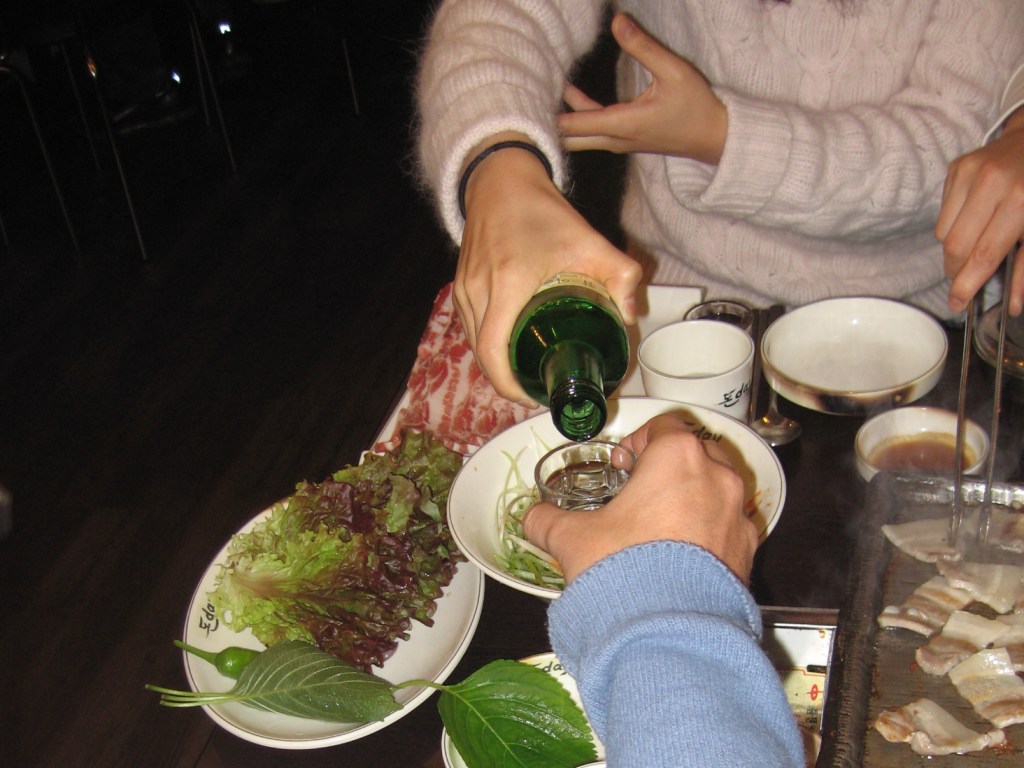
The same relationship becomes visible before the glass ever reaches the mouth.
When receiving a drink, a younger or junior person may hold the glass in the right hand while supporting it with the left, or simply hold it with both hands.
When pouring, the bottle is commonly held in the right hand while the left supports the wrist, forearm, or bottle.
There is no single hand position that everyone reproduces perfectly. The important point is that the second hand makes the exchange look attentive rather than casual.
One traditional explanation is practical as well as symbolic. When people wore clothing with long sleeves, the left hand could help control or support the right sleeve so that it would not brush against the food while alcohol was being poured.
Over time, the controlled two-handed posture became associated with courtesy. This is best treated as a traditional explanation for the gesture rather than the only possible point of origin.
Among peers, the additional formality may disappear. Friends of the same age may hold their glasses one-handed, pour casually, and drink while facing one another without anyone interpreting it as disrespectful.
Even in traditional drinking customs, the rules between equals were generally less detailed than those governing encounters with elders.
What About Clinking Glasses?
At a more formal table, the oldest, highest-ranking, or hosting person may lead the first toast.
A younger participant may support the glass with the free hand and, in some settings, hold its rim slightly lower than the senior person’s glass when they touch.
Keeping the glass lower is a recognizable form of deference, particularly at workplace dinners or formal family gatherings.
It is not, however, a universal rule that every Korean measures at every toast. A gentle clink and attention to the person leading the table matter more than turning the moment into a glass-height competition.
With close friends, the ritual may be no more complicated than saying 짠—jjan, the Korean sound associated with glasses clinking, and drinking normally.
Some older etiquette guides also present finishing the first glass in one shot as a firm rule. That may still happen, but treating it as a requirement would misrepresent many present-day Korean gatherings.
Whether someone finishes the drink increasingly depends on the people, the setting, the type of alcohol, and the drinker’s own choice.
Do Young Koreans Still Turn Away When Drinking?
Yes—but selectively.
Many younger Koreans still know the gesture and may use it when drinking with grandparents, older relatives, professors, bosses, or senior colleagues.
It can be especially noticeable during a first meeting or at the beginning of a formal meal.
The same person may completely drop it while drinking with close friends.
A younger Korean may maintain recognizable forms of politeness while rejecting pressure to consume more alcohol than they want.
The wider culture surrounding alcohol is also changing.
Repeated late-night company-drinking rounds are less dominant than they once were, and younger adults are increasingly likely to drink less frequently, choose nonalcoholic options, or avoid company dinners that revolve around heavy drinking.
The older workplace culture has not disappeared everywhere. Some employees still experience pressure to attend dinners or continue drinking.
But refusing another glass, leaving after the meal, or choosing not to drink at all is becoming more socially acceptable.
This explains why contemporary Korean drinking culture can appear contradictory.
A young employee may carefully receive the first glass with both hands but decline another round, choose a nonalcoholic drink, or leave after dinner.
The respectful gesture remains recognizable. Compulsory heavy drinking is steadily losing legitimacy.
COMMON MISUNDERSTANDING
Korean drinking etiquette does not mean that a younger person must drink.
Turning away is meaningful only after someone has chosen to take a sip. It does not remove their right to refuse alcohol.
Modern courtesy should include respecting the answer when someone says that they do not drink or have had enough.
What Should a Foreigner Actually Do?
There is no need to reproduce every movement as if it were choreography.
At a clearly formal table, use both hands when receiving the first drink.
If you are drinking with someone who is noticeably older or senior, make a small turn to the side before taking the sip. Some people also lightly cover the side of the glass with their free hand.
When returning the gesture, hold the bottle in your right hand and support it with your left.
During a toast, follow the timing set by the senior or host. Holding your glass slightly lower can be a polite touch when it happens naturally, but the exact height is far less important than being attentive and relaxed.
Once the table becomes casual, follow the people around you.
When same-age friends are drinking normally, continuing to turn dramatically away at every sip may look more theatrical than respectful.
Foreign guests are rarely expected to understand every unwritten detail. A natural two-handed receive and a small side turn in an obviously formal setting usually communicate enough.
If you do not drink, you can simply say:
저는 술을 잘 못 마셔요.
Jeoneun sureul jal mot masyeoyo.
“I do not handle alcohol well.”
Or:
오늘은 안 마실게요.
Oneureun an masilgeyo.
“I will not drink today.”
You do not need to accept a shot first in order to make the refusal polite.
The Gesture Is a Social Subtitle
The movement is small because its message is social rather than theatrical.
It can reveal who is senior, how formal the gathering is, and how much distance still exists between the people at the table.
When the senior person tells everyone to relax and the formal gestures gradually disappear, that change carries meaning too: the relationship is becoming more comfortable.
So the next time a younger character turns sideways with a soju glass in a Korean drama, they are probably not hiding the alcohol.
For a brief moment, their body is telling you how the entire table is organized.
 KSPILL
댓글을 달려면 로그인해야 합니다.