
ARTICLE
A red pen looks harmless until you use it to write a Korean person’s name.
Maybe you are labeling a coffee cup, signing a birthday card, or writing a student’s name on a classroom board. Then someone stops you:
“Don’t write my name in red.”
The reaction may be playful, genuinely uncomfortable, or somewhere in between. The reason is a long-standing Korean taboo: writing the name of a living person in red is associated with death, bad luck, or the idea of wishing harm upon them.
The childhood version is much more dramatic: If you write someone’s name in red, they will die. The National Folk Museum of Korea describes it as a familiar warning that Korean children have used to tease—or frighten—one another for generations.
THE CONTEXT
The taboo applies most strongly to deliberately writing a living person’s name in red. It does not mean that every red word, correction mark, logo, stamp, or screen graphic is considered unlucky.
What Does a Name in Red Ink Mean in Korea?
In its simplest form, the belief connects a red-written name with death or serious misfortune.
That does not necessarily mean the writer literally believes the ink can kill someone. For many Koreans, the act feels wrong because it carries a hostile or death-related implication. Depending on the situation, it can resemble marking someone as dead, inviting bad luck, or symbolically wishing that person harm.
This is why the same person who happily uses a red pen to underline a sentence may hesitate to write another person’s name with it. The problem is not the pen by itself. It is the combination of the color, a personal name, and the person being alive.
Contemporary discussions show a wide range of reactions. Some people say they do not believe the superstition but still feel uncomfortable. Others treat it as a joke from childhood. Teachers in Korea have also reported students reacting dramatically when their names appeared in red, even when the students did not seem to expect any real danger.
Is the Taboo Really Connected to Dead People?
Yes, the modern meaning is clearly connected to death. But the historical origin is less certain.
Several explanations are commonly repeated:
- Names of deceased people were written in red.
- Family genealogies used red to distinguish the dead from the living.
- Criminals or people sentenced to death had their names recorded in red.
- Red represented blood.
- The practice came from an older Chinese custom.
The difficulty is that these stories are often presented online as if one of them were the proven origin. The available evidence does not support that level of certainty.
The National Folk Museum of Korea notes that red was sometimes associated with writing the names of deceased people and with correcting written characters. However, the museum’s own discussion presents several competing origin stories rather than identifying one conclusively documented beginning.
What Joseon-Era Records Actually Show
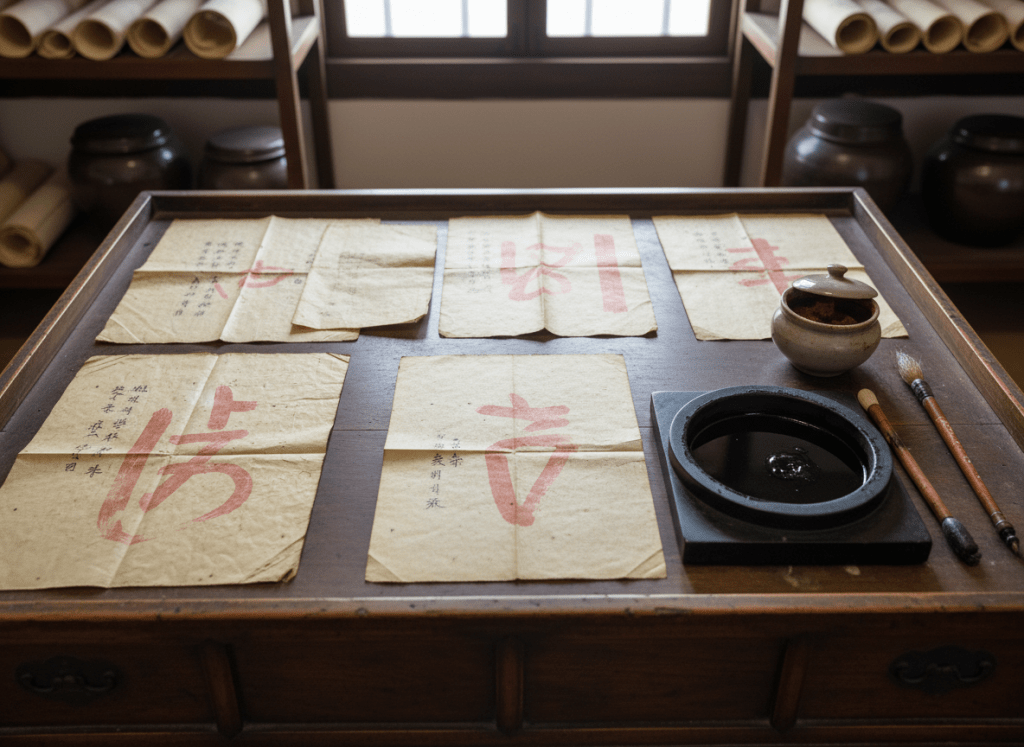
There is genuine historical evidence connecting a person’s name written in red with crime, punishment, and official disgrace.
The Annals of the Joseon Dynasty contain references to a document called a danseo (단서, 丹書). The historical glossary defines it as a document in which a criminal’s offense and name were written in red.
A 1711 entry discusses an official whose name had remained in such a record for 12 years after misconduct involving a state examination. He had been punished and exiled, and the court was considering whether he should be allowed to return to public office. He was not awaiting execution.
This distinction matters.
The record confirms that red-written names could carry an official association with wrongdoing, punishment, exclusion, and public stigma during the Joseon period. But it does not prove the simplified claim that red ink was used only for death-row prisoners or that the modern taboo began with execution lists.
A more accurate conclusion is:
Joseon records support a connection between red names and people placed under serious official condemnation. The narrower execution-only explanation remains unproven.
What About Jokbo, or Korean Family Genealogies?
Another popular explanation involves jokbo (족보), traditional Korean family genealogies.
According to this story, the names of deceased relatives were written or marked in red, so writing a living person’s name the same way symbolically treated that person as already dead.
There may have been families, periods, or individual documents in which red annotations were used. However, it is risky to describe this as one universal rule followed in all Korean genealogies.
Sungkyunkwan University’s Korean Genealogy Database describes jokbo as records containing names, family relationships, government positions, birth years, death years, and other biographical information. It does not establish a nationwide convention in which every deceased person’s name was printed or written in red.
So the jokbo explanation is best understood as one widely circulated account of the taboo, not a fully proven origin that applied identically to every Korean family record.
Are the Qin Shi Huang and Ancient Egypt Stories True?
Stories involving China’s first emperor, Qin Shi Huang, also circulate. One version claims that the emperor reserved red writing for himself and severely punished anyone who used it improperly. Another origin story reaches as far back as ancient Egypt and a ruler offended by a red-colored portrait.
The National Folk Museum of Korea mentions these as possible folk explanations, but neither is presented with enough historical documentation to establish it as the source of the Korean custom.
These stories may help explain how people have tried to make sense of the taboo after the fact. They should not be repeated as settled history.
The most responsible answer is that the custom probably developed through overlapping associations: death and memorial practices, criminal stigma, red correction marks, the visual suggestion of blood, and stories passed between generations.
There is no single verified moment when all Koreans agreed that living names should never be written in red.
Red Is Not Simply “The Color of Death” in Korea
It would be misleading to conclude that red itself is an unlucky color in Korean culture.
In traditional folk practices, red could have the opposite meaning. It was often believed to possess protective power.
For example, Koreans traditionally ate and placed red bean porridge around the home during Dongji, the winter solstice, because the red color was believed to repel harmful spirits. Red beans and other red objects could therefore represent protection rather than death.
This is an important part of the cultural context:
Colors do not carry one permanent meaning. Their meaning changes according to the object, action, and situation.
Red beans could drive away misfortune. Red decorations could appear celebratory. Red marks could indicate corrections. And a red impression from a seal could make a document official.
But a living person’s handwritten name in red developed its own negative association.
Why Are Red Korean Name Seals Acceptable?
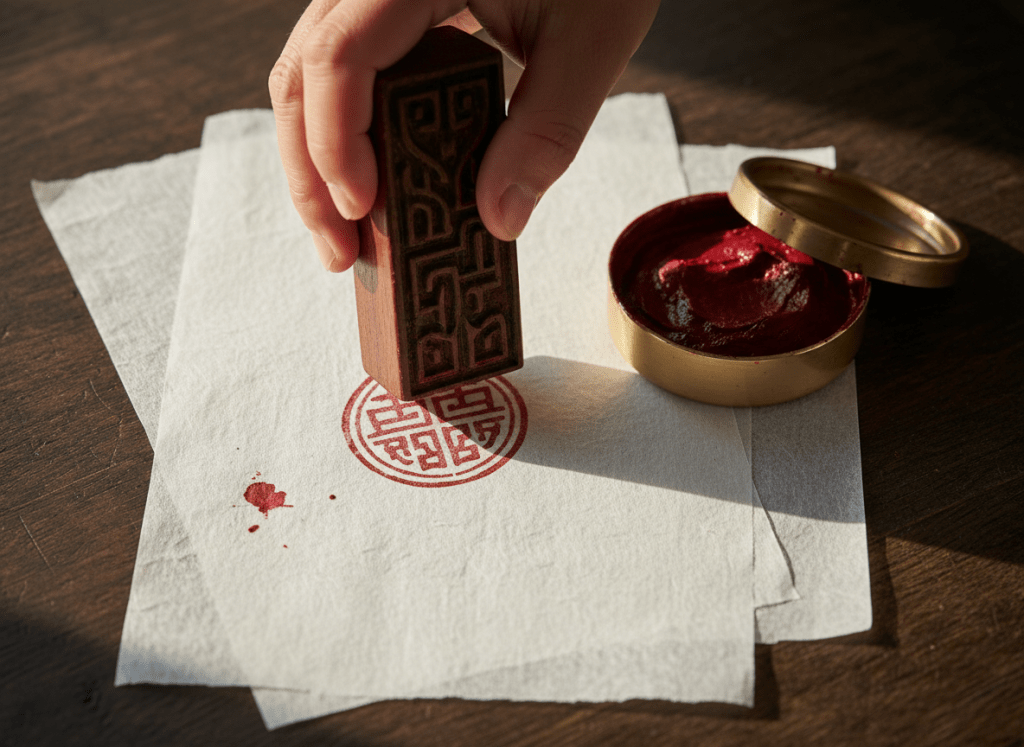
This apparent contradiction often confuses foreigners.
If writing a living person’s name in red is taboo, why can Koreans press a dojang—a personal name seal—into red paste?
Because a seal belongs to a completely different cultural category.
A red seal impression is not normally understood as someone casually writing a person’s name in red. It is a standardized mark of identity, authorization, ownership, or official approval.
Historically, Korean seals were used to authenticate documents, and red ink or pigment was the conventional medium used to make the impression visible. The National Palace Museum of Korea describes Emperor Gojong’s state seal as his signature on official correspondence. Historical Korean seals were commonly pressed in red ink, and the seal was what gave a document formal authority.
So the meanings are almost opposite:
A handwritten red name can suggest death or misfortune.
A red seal can confirm that a person is present, identified, and authorizing something.
This is not a logical inconsistency once the two actions are viewed in their cultural contexts. One is an informal act carrying a taboo association. The other is a recognized method of authentication.
Do Younger Koreans Still Care?
There is no reliable nationwide survey showing exactly how many young Koreans believe that a red-written name causes bad luck.
What can be said more safely is that awareness remains broader than literal belief.
Many younger Koreans know the rule because they heard it from parents, teachers, classmates, or childhood friends. Some continue to avoid red names automatically. Others consider it an outdated superstition and will laugh if someone mentions it.
A common middle position is:
“I don’t believe anything will happen, but why write it in red when another color is available?”
Anecdotal discussions among Koreans and foreign residents reflect that divide. Some report children becoming frightened or performing exaggerated reactions, while others say their students or friends barely notice. Several participants say sensitivity appears to be declining, but that older people—and some younger people—may still find the act unpleasant or disrespectful. These comments are useful illustrations, not representative polling.
Context also matters.
A name that happens to appear in red in a game, presentation, advertisement, or digital interface may attract little attention. Deliberately handwriting someone’s name in red on a personal card, gift, classroom list, or note is more likely to activate the old association.
What Happens If a Foreigner Writes a Korean Friend’s Name in Red?
Usually, nothing serious.
A Korean friend may laugh, take the pen away, or tell you to rewrite the name. Someone who knows that you are unfamiliar with the custom will probably assume it was an innocent mistake.
Possible reactions include:
“You’re not supposed to do that.”
“Why did you write my name in red?”
Or the classic dramatic joke:
“Are you trying to kill me?”
The reaction may be stronger if the person is older, the situation is formal, or the name appears on something personal such as a letter, invitation, gift card, or classroom material. Cultural guides for foreign residents have therefore advised avoiding red ink when writing the name of a living recipient.
The intention also changes the meaning. An accidental mistake by a foreign visitor is unlikely to cause lasting offense. Continuing to do it after someone has asked you to stop can feel provocative because it shows that you understand the association and are using it deliberately.
The easiest solution is simply to use black or blue ink for personal names. If you make a mistake, say that you did not know the custom and rewrite it. No elaborate apology is needed.
Is It a Superstition or a Form of Etiquette?
Historically and conceptually, it is a superstition: there is no evidence that the color used to write a name can determine whether someone lives or dies.
Socially, however, it often functions more like etiquette.
A person does not need to believe in supernatural consequences to recognize that an action carries an unpleasant meaning. Many cultural habits survive in exactly this way. The original belief weakens, but the feeling that something is inappropriate remains.
That is why the red-name taboo has not simply disappeared among younger generations. It survives not because every Korean fears literal death, but because enough people still recognize what the gesture can imply.
The practical rule is simple:
Red ink is not forbidden in Korea. But unless you know the person will not mind, avoid using it to write the name of someone who is alive.
SEO
SEO Title: Why Koreans Don’t Write Names in Red Ink | KSPILL
Meta Description: Why is writing a living person’s name in red ink taboo in Korea? Learn its link to death, uncertain origins, red seals, and what Koreans think today.
Primary Keyword: why Koreans don’t write names in red ink
Secondary Keywords: Korean red ink superstition, writing names in red Korea, red pen Korean culture, Korean name taboo, Korean red name meaning, dojang red ink
URL Slug: why-koreans-dont-write-names-in-red-ink
Category: Korean Culture
Tags: Korean Culture, Korean Superstitions, Korean Etiquette, Korean Names, Red Ink, Dojang, Joseon History
Homepage Excerpt: A red pen seems harmless—until it touches a living person’s name in Korea. Here is what the taboo actually means, which historical explanations hold up, why red seals are acceptable, and why many younger Koreans still avoid it even without believing the superstition.
SOURCES & REPORTING
- National Folk Museum of Korea: Used to document the familiar childhood belief, the association with deceased names and corrections, and the existence of multiple competing origin stories. Its speculative stories were treated as folklore, not established historical fact.
- Annals of the Joseon Dynasty: Primary historical evidence for danseo, defined as a document recording a criminal’s name and offense in red, including a 1711 case involving punishment and later reinstatement rather than execution.
- Sungkyunkwan University Korean Genealogy Database: Used to verify the kinds of information recorded in Korean genealogies. The source documents birth and death records but does not establish a universal rule that deceased names in jokbo were always written in red.
- National Palace Museum of Korea and Korea JoongAng Daily: Used to explain the historical function of seals as signatures and authentication marks, as well as the conventional use of red ink for seal impressions.
- Korea.net: Used to confirm that red also carried protective meanings in Korean folk culture, particularly in Dongji red bean traditions.
- Contemporary discussion samples: Comments from Koreans, teachers, and foreign residents were used only to illustrate the range of present-day reactions. They were not treated as representative survey data.
Reporting status: Reviewed and updated through August 27, 2026. No reliable nationwide age-group survey on current belief in the red-name taboo was identified, so generational differences are described as tendencies rather than statistical conclusions.
 KSPILL
댓글 남기기