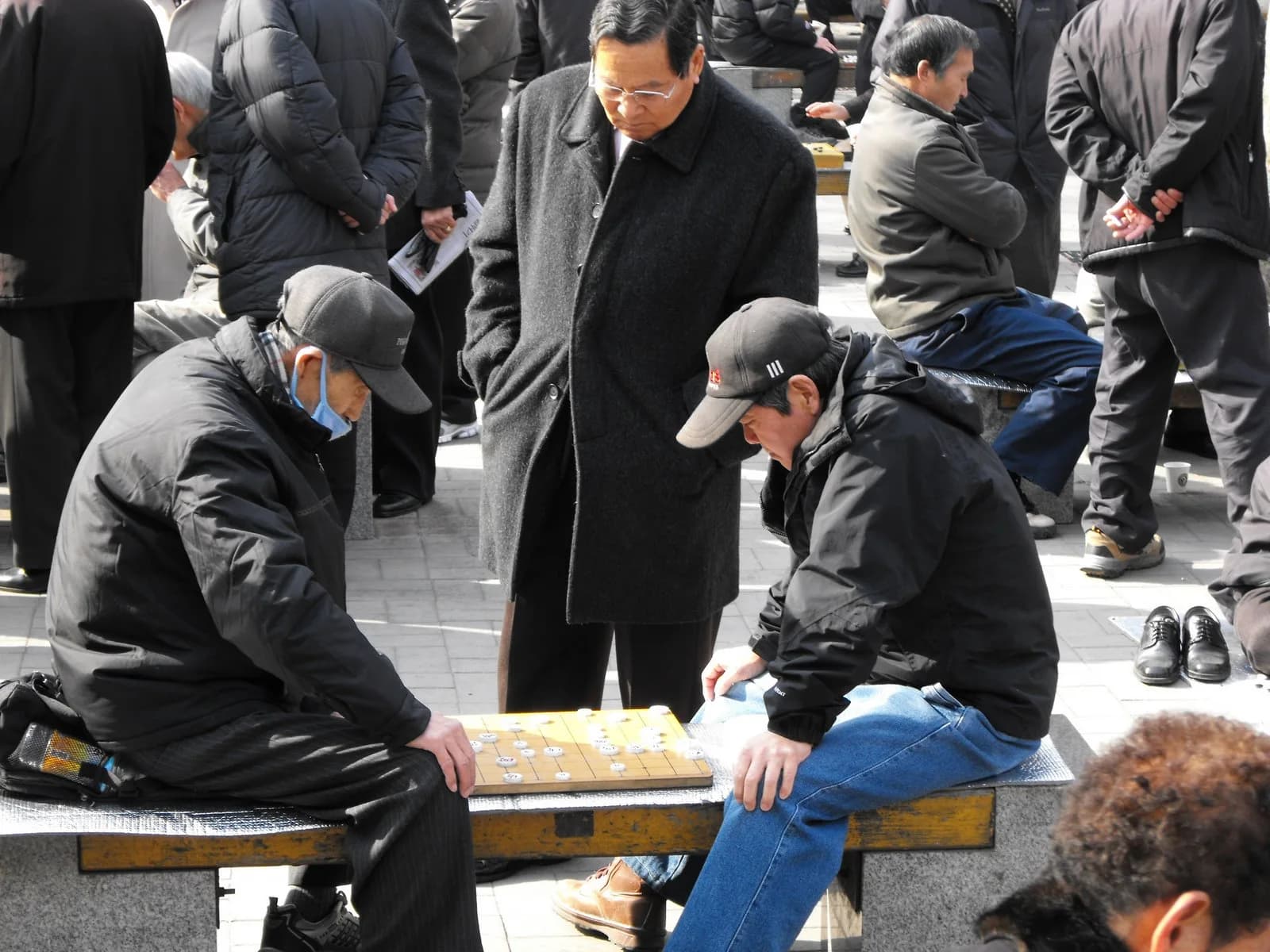
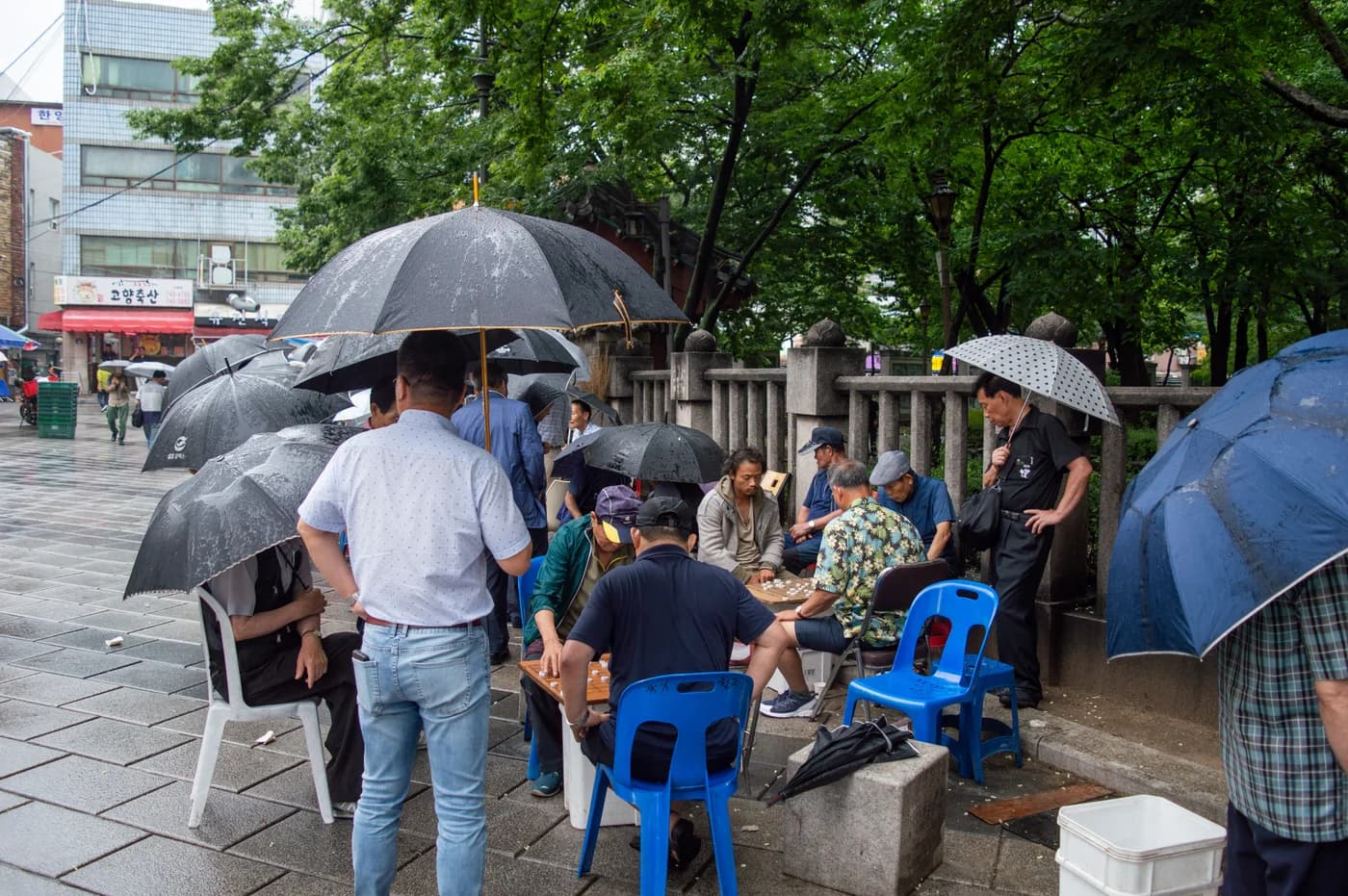
In Korean parks, senior community centers and pavilions, you may see two people facing each other over a board with a few spectators behind them. Janggi is a Korean strategy game in which two players move 32 pieces to trap the opposing general. Often called “Korean chess” in English, it is not simply chess with a Korean name. Its pieces, starting formations, movement rules and even the conversation around the board have their own character.
The spectators gathering around older players show how a match can become a quiet social occasion. That does not mean every older person, or every Korean, enjoys janggi. Public games have nevertheless long been documented as familiar settings for conversation among neighbors and across generations.
How a Janggi Match Works
Janggi uses a nine-by-ten board. Each player has 16 pieces: one general, also called a king; two each of the chariot, cannon, horse, elephant and guard; and five soldiers. The sides are usually marked Cho and Han.
The aim is to leave the opposing general without a safe move. In this game modeled on military formations, balancing attack and defense, controlling the center and anticipating the opponent's next move matter more than simply capturing the most pieces.
The palaces at either end of the board contain diagonal lines. These affect the movement of guards and generals, as well as the attacking paths of some other pieces. The palace may look unfamiliar to a newcomer, but it is where some of janggi's distinctive tactics take shape.
Why a Janggi Cannon Needs a Piece to Jump
Each piece moves differently. The chariot travels in straight horizontal or vertical lines. The horse moves one step straight, then one step diagonally. The elephant follows a longer diagonal path. Soldiers move forward or sideways, but cannot retreat.
For beginners, the cannon, or po, is often the most intriguing piece. It must jump over one other piece to move or capture, but cannons cannot jump over one another. A single piece can open or block its path, making the cannon an attacking piece that demands careful calculation.
That is why fewer pieces do not necessarily make janggi easier. Removing just one intervening piece can completely change a cannon's route and lines of attack.
Hunsu: Advice From Around the Park Board
Sometimes the people watching look more serious than the players. A word often heard in this setting is hunsu: advice from the sidelines, originally about moves in games such as baduk or janggi.
“Not there—move the chariot!” can add to the fun of watching. Repeated advice while a player is thinking, however, can interrupt the tension of a match. Beyond board games, hunsu is also a casual Korean term for unsolicited advice.
If you stop to watch a public game, a considerate approach is simple: check that there is room before moving closer, leave the board and pieces untouched, and gauge the players' response before offering advice. Quiet attention can be a friendly gesture in itself.
More Than an Older Generation's Game
Janggi has long been presented in Korea as a thinking game for people of different ages and genders. The Academy of Korean Studies' Encyclopedia of Korean Culture cites related records dating to early Goryeo and explains that the name “janggi” appears in texts from the middle Joseon period onward.
Older players can be particularly visible in parks and rest areas. A board may therefore bring to mind retirement leisure, neighborhood encounters or competition between old friends. But janggi need not belong to one generation. For someone just learning the rules, it also offers the pleasure of reading another person's choices and resisting a rushed decision.
What lasts longer than the result may be the time spent around the board: someone waiting for the next move, someone quietly nodding, someone holding back advice. Not everyone gathered there moves a piece, but they all help shape the occasion.
Korean Words You May Hear at a Janggi Match
- Janggun: Announces that the opposing general is under attack.
- Meonggun: A response to janggun, indicating that the threat has been escaped.
- Hunsu: Advice about moves from the sidelines; also widely used for unsolicited advice.
- Cho and Han: The labels for the two opposing sides.
Rather than memorizing every move at once, a newcomer can start by watching the differences between the chariot, horse and cannon. Then a brief “janggun” heard in a park may sound less like an exclamation and more like the announcement of a carefully calculated move.
Sources on Janggi's Rules and Social Setting
- Encyclopedia of Korean Culture, “Janggi” — game definition, board layout, pieces, rules, and historical references.
- Korea.net, “A journey into steam” — an example of janggi being played by older men in a shared leisure setting.
- Korea.net, “Korean Uzbek photographer records Goryeoin life in Central Asia” — documentation of older Goryeoin men playing janggi.