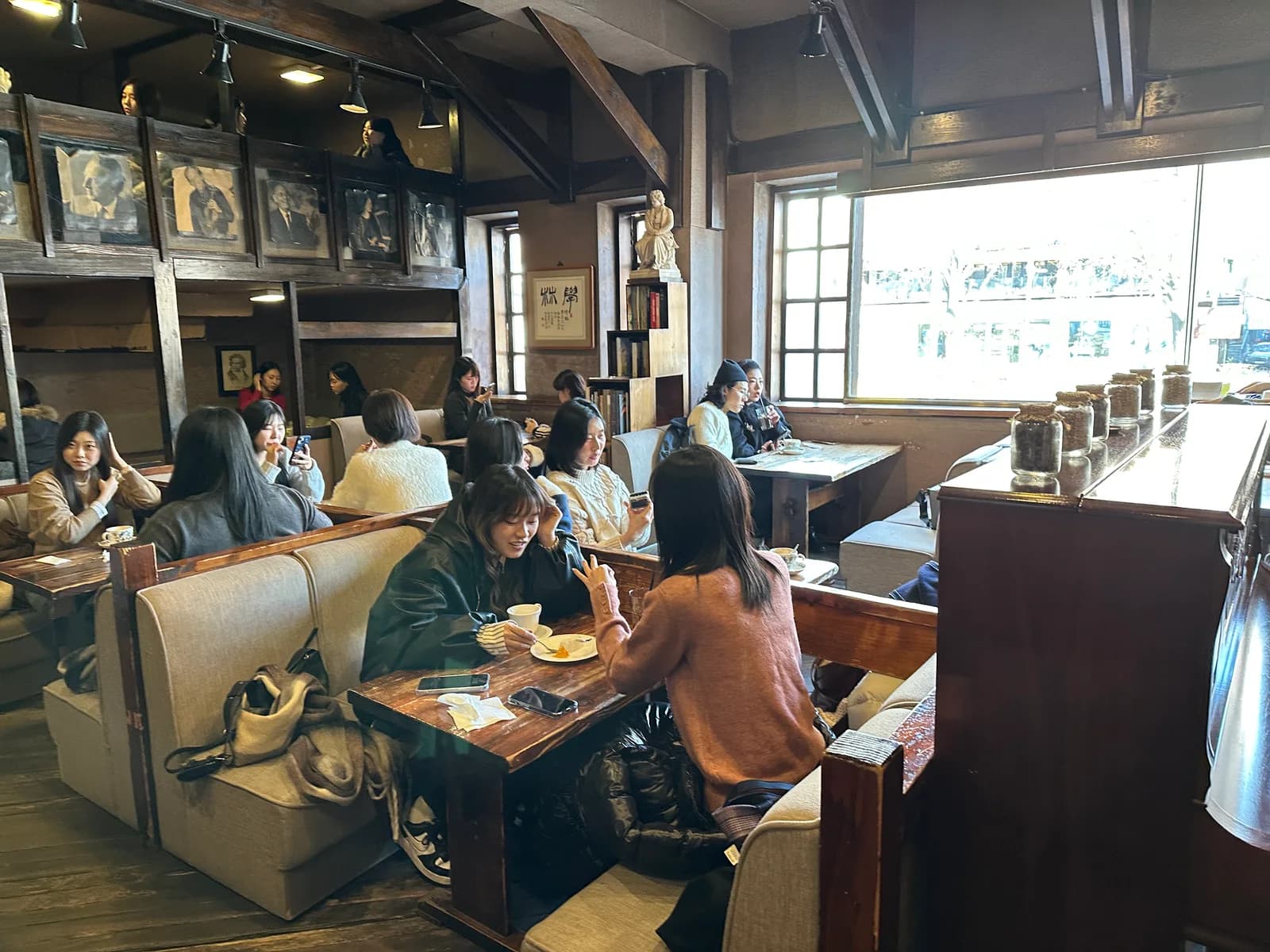
A dabang (다방, literally “tea room”) is an old-style Korean place to sit, drink tea, coffee, or other beverages, and spend time talking. In contemporary Korean memory, it usually suggests a pre-franchise coffee-room atmosphere: slower service, familiar regulars, music, and often distinctly retro décor. It is not automatically a traditional tea ceremony venue—and despite its name, coffee became central to the modern dabang. (encykorea.aks.ac.kr)
The short answer: a social room, not one fixed drink
If a café is built around espresso, takeout, and a changing specialty menu, the classic image of a dabang is built around staying awhile. Historically, dabangs functioned as places to meet a friend, wait for someone, make a call, hear music, or talk over a drink. Seoul’s museum describes them as modern spaces where customers encountered coffee, tobacco, beer, and even the telephone. (museum.seoul.go.kr)
That makes “old-style coffee room” a more useful translation than simply “tea house” in many present-day contexts. It also differs from the fast modern café routine behind Korea’s year-round iced Americano habit. Still, each business sets its own menu and mood: a sign reading 다방 does not guarantee one particular drink, price point, or interior.
Why is it called a tea room if people drink coffee?
The word has a much older life than the coffee shop. In the Goryeo period, dabang referred to a state office responsible for tea as well as items such as alcohol and fruit; in Joseon, it was connected to official reception rituals for foreign envoys. This was not a public café in the modern sense. (encykorea.aks.ac.kr)
Coffee arrived much later. The Seoul Museum of History traces coffee references in Korea to the late nineteenth century and notes the appearance of Japanese-style tea shops in 1908. By the 1920s, modern dabangs had begun to take shape as urban gathering spots. (museum.seoul.go.kr)
So the name stayed, while the social purpose evolved. A dabang could serve tea, but it became one of the key rooms through which coffee entered everyday urban culture.
From literary hangout to everyday meeting point
In colonial-era Gyeongseong—the name used for Seoul under Japanese rule—dabangs attracted writers, painters, musicians, filmmakers, and intellectuals. The Seoul Museum of History identifies them as sites where a new urban popular culture took shape, rather than merely places to buy a beverage. (museum.seoul.go.kr)
After liberation in 1945 and the Korean War, dabangs also became flexible public living rooms in a country with limited cultural facilities. The Encyclopedia of Korean Culture records exhibitions, literary and film nights, publication events, reunions, classes, and other gatherings taking place in dabangs. (encykorea.aks.ac.kr)
From the 1960s through the 1990s, they were widely used as meeting places before today’s chain cafés became dominant. Music—sometimes selected by a DJ—was part of the appeal at dedicated music dabangs, while other shops served customers making business appointments or simply passing time. (encykorea.aks.ac.kr)
What might you find inside a dabang?
There is no universal formula, but a surviving or retro-styled dabang may have cushioned booths, wood furniture, framed photographs, old clocks, LP records, a turntable, or an upright piano. The visual language is often less about recreating one exact decade than evoking the long pre-franchise café era.
Hakrim Dabang (also written Hangnim Dabang) in Seoul’s Daehangno area is a well-known example of that continuing legacy. Opened in 1956, it was associated with students and people in music, art, and drama circles; Seoul identifies it as a historic meeting place, while tourism materials point to its vintage furnishings and music-focused atmosphere. (english.seoul.go.kr)
Dabang coffee and the retro appeal
For many people, the word dabang also brings to mind dabang coffee: often a sweet, creamy instant-coffee style rather than a carefully dialed-in pour-over or espresso. Instant coffee spread through postwar coffee culture and was used in dabangs to make mix coffee, according to Koreana. (koreana.or.kr)
But do not treat that as a rule. Some historic dabangs roast coffee, sell Viennese-style coffee, or offer a broader café menu. Others may focus on tea or inexpensive everyday drinks. If you are visiting, read the menu rather than assuming every dabang serves the same nostalgic cup.
One word, several associations
The word dabang can feel warmly nostalgic, especially in dramas, films, and retro-themed neighborhoods. Korea’s official tourism organization describes dabangs as traditional Korean-style coffeehouses and popular meeting places during the late twentieth century. (english.visitkorea.or.kr)
Yet the term has also acquired negative associations in some contexts, particularly through the phrase ticket dabang (tiket dabang, 티켓다방), which has been linked to businesses involving exploitative sexual services. That does not describe every shop called a dabang, and it is best not to make assumptions about a business or its staff based on the word alone. The phrase is a reminder that a familiar-looking Korean term can carry different social meanings depending on context. (encykorea.aks.ac.kr)
How to read a 다방 sign as a visitor
When you see 다방 on a Korean sign, think: “a tea/coffee room with history,” not “a guaranteed traditional tea experience.” It may be a decades-old local institution, a deliberately retro café, or simply a business using an older name.
A useful question is: “커피 있어요?” (Keopi isseoyo? — “Do you have coffee?”). If you want a less sweet drink, ask “안 달게 해 주세요” (An dalge hae juseyo — “Please make it not too sweet”), though whether that is possible depends on the drink.
The lasting charm of the dabang is not just its coffee. It is the idea of a room where the drink gave people a reason to linger—and where conversation, music, work, and city life could unfold around a small table.