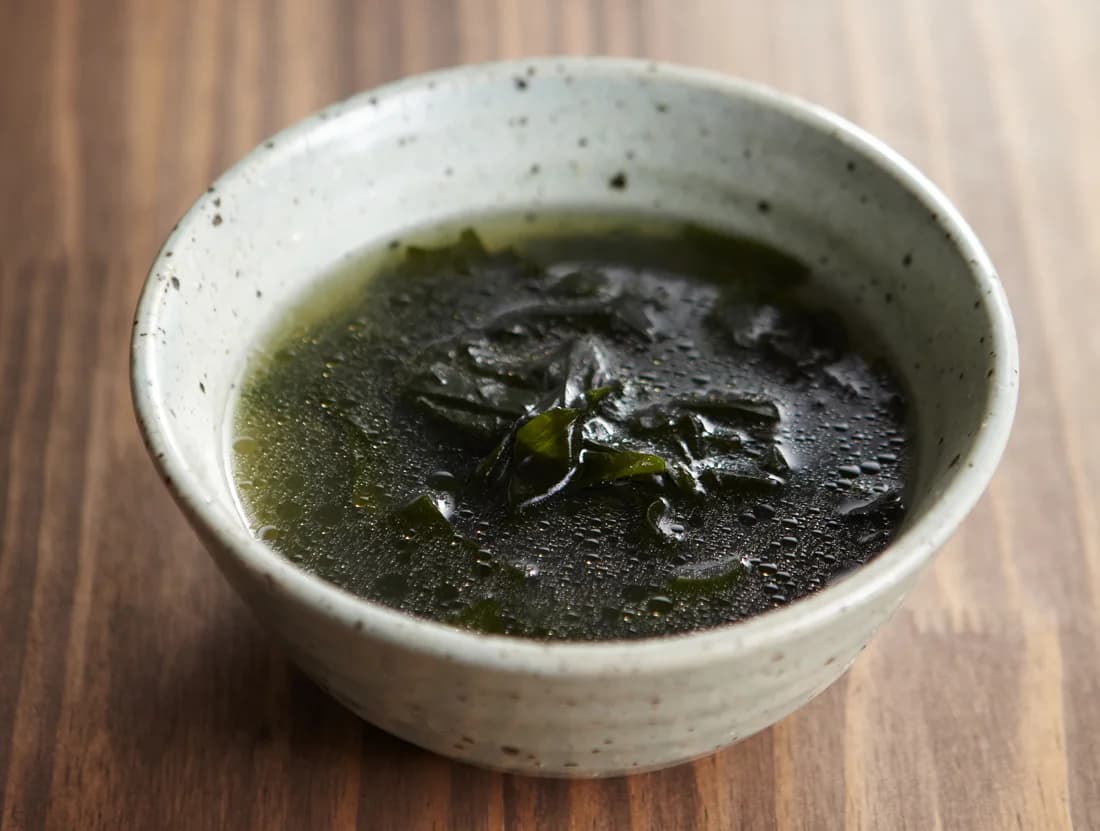
A bowl of miyeok-guk (미역국)—Korean seaweed soup—is a familiar birthday food because it connects a person’s birthday to childbirth. The soup has long been associated with postpartum meals for new mothers, and serving it on a birthday can express remembrance and gratitude for the mother or parent who gave birth. It is a meaningful custom, not a rule that every household follows in exactly the same way.
First, what is miyeok-guk?
Miyeok means edible brown seaweed, commonly called wakame in English and Japanese food contexts. Guk means soup. In a classic home-style version, softened dried seaweed is cooked with sesame oil, garlic, soy sauce and water or broth; beef is common, while clams, mussels, fish or abalone may appear in coastal and family-specific variations.
The result is not usually a flashy celebration dish. It is savory, gentle and deeply associated with home cooking. It is commonly served with rice and shared alongside other birthday foods, which may include cake, japchae, grilled meat or whatever the celebrant enjoys.
The link between seaweed soup and childbirth
The core of the birthday custom is Korea’s tradition of serving miyeok-guk to people after childbirth as part of postpartum care. In older childbirth customs, food was not simply fuel: it was part of the household’s care for a recovering parent and a new baby.
Seaweed was valued as a nourishing ingredient, and warm soup was an accessible, restorative meal. Historical Korean medical writing, including the Joseon-era Dongui Bogam, discussed seaweed’s properties; today, seaweed is also recognized as a food that can contain substantial iodine. That does not make miyeok-guk a medical treatment, however. People with thyroid conditions, those taking iodine-related medication, or anyone advised to limit iodine should follow guidance from a qualified clinician rather than treating seaweed soup as automatically beneficial.
How postpartum soup became birthday soup
A birthday marks the day someone was born, but the miyeok-guk tradition shifts attention briefly to the person who gave birth. The bowl can say: this day is not only about the birthday person growing older—however age is counted in Korea—it is also a day to remember the labor, recovery and care that began their life.
That is why the dish is often described as an edible expression of appreciation for one’s mother. In practice, the meaning can be broader and personal. Some people make it for a parent, partner, child, friend or themselves; others may understand it chiefly as comfort food or a family habit. The sentiment is widely recognizable, but no single emotional interpretation applies to every Korean family.
Is the whale story the true origin?
You may hear that people began feeding seaweed to new mothers after observing whales eat seaweed following birth. This is a well-known traditional origin story, and it is repeated in Korean cultural accounts. But it is best understood as one transmitted explanation, not as conclusive proof of one exact moment when the birthday custom began.
The more firmly supported cultural connection is the longstanding association of miyeok-guk with childbirth and postpartum care. That association made the soup an especially fitting birthday food over time. In other words, the symbolism matters more than pinning the custom to a single origin anecdote.
What happens on birthdays now
For many people, miyeok-guk is eaten at breakfast on a birthday, perhaps before school or work, while others have it at lunch, dinner or during a family gathering. A parent may cook it, a friend may order it from a restaurant, or the birthday person may make it themselves.
A question such as “Did you eat miyeok-guk?” can function as a warm birthday check-in. It does not mean that a birthday without soup is incomplete. Modern celebrations vary by generation, city, schedule, religion, family structure and personal taste. Some people happily keep the ritual; some skip it; some choose a meat-free or seafood version.
Korean dramas also use the soup as emotional shorthand. A steaming bowl prepared by someone else can suggest affection and belonging. A character eating it alone may underline loneliness. Those scenes work because viewers recognize the soup’s ordinary, domestic associations—not because miyeok-guk is only for birthdays.
A small bowl with a big idea
Miyeok-guk is ultimately a birthday tradition built around relationship rather than luxury. Its presence at the table can celebrate the person whose birthday it is while acknowledging the beginning of their life and the care surrounding it.
So if you are invited to a Korean birthday meal and seaweed soup appears, the most useful translation is not just “birthday soup.” It is a quiet reminder that a birthday can be a family memory, too.