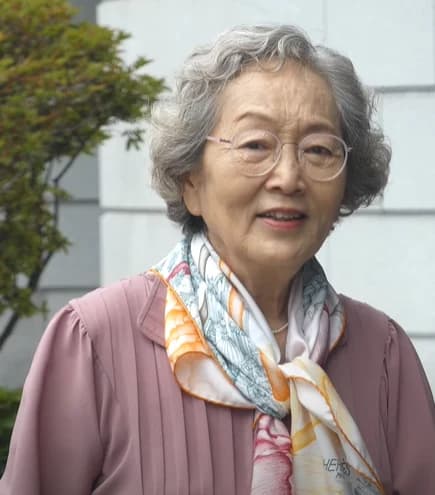
Go Yeon-hong (Kim Young-ok) is the emotional anchor of Our Sticky Love: Jang Tae-ha’s grandmother, a master maker of yeot—Korean malt taffy—and a woman living with dementia. In a Netflix romantic comedy built around an amnesiac prosecutor and a boxing coach’s risky lie, Yeon-hong gives the village story its longer memory. She represents work done by hand, affection delivered practically, and an elder’s authority that can feel formidable precisely because it is rooted in care. Our Sticky Love is available as a Korean limited series on Netflix’s official title page.
Go Yeon-hong’s role: the grandmother who makes the village feel like home
Official character publicity describes Yeon-hong as a traditional yeot artisan and Tae-ha’s grandmother, while also establishing that she lives with dementia. Those details matter together. Her work places her at the center of the drama’s taffy-making village, where food craft is not mere background décor; it is a livelihood, a local identity, and a source of routine.
For Tae-ha, “grandmother” is more than a family-tree label. It signals an elder who has the standing to worry about him, rebuke him, feed him, and expect him to return. The story does not need to treat her as soft-spoken to make her loving. In Korean screen families, a grandmother’s bluntness can carry the force of a relationship built over decades: she has earned the right to interfere because she has also taken responsibility.
That should not be read as a rule about every Korean family. Real families differ enormously in closeness, language, household structure, and expectations. But Yeon-hong draws on a recognizable dramatic shorthand: the older relative whose sharp words are inseparable from a long record of showing up.
Why a yeot artisan is such a meaningful detail
Yeot (엿) is a traditional Korean sweet made by slowly cooking grains, often with malt, into a dense, chewy syrup or candy. It requires patience, physical labor, and practiced timing. That makes Yeon-hong’s occupation an especially apt fit for a character associated with endurance and family continuity.
The English title Our Sticky Love captures yeot’s clingy texture, but the Korean title’s wordplay is much rougher and more mischievous. Yeon-hong’s craft grounds that wordplay in something tangible: sweetness is made, stretched, handled, and shared. In this setting, food is also a form of practical language.
For international viewers, it helps to look beyond the assumption that a meal, snack, or packed container of food is simply a sentimental gesture. In many Korean households, offering food can be a direct way to check whether someone is coping: Have you eaten? Are you warm? Do you have enough to take with you? Care may arrive as an instruction, an extra portion, or an errand completed before anyone says “I love you.” Yeon-hong’s role makes that kind of unsentimental tenderness legible.
Her scolding is not the opposite of affection
A grandmother figure in a Korean drama may scold because she sees danger, irresponsibility, loneliness, or a failure to care for oneself. The emotional point is often not whether the reprimand is gentle. It is whether the person has been watched over closely enough for the reprimand to mean something.
That is the tension Yeon-hong brings to Tae-ha’s world. Her authority is domestic rather than official, but it is still authority: she holds family history, knows the village’s rhythms, and has moral permission to call a younger person to account.
At the same time, viewers should resist romanticizing all elder authority. Respect for elders can be deeply meaningful, but it can also involve pressure, disagreement, and unequal expectations. Our Sticky Love uses the grandmother figure for warmth and emotional stakes; it should not be mistaken for a complete portrait of Korean intergenerational life.
Family memory—and the vulnerability of losing it
The dementia element gives Yeon-hong’s place in the story added weight. She is connected to memory, ritual, work, and the sense of who belongs to whom; dementia makes memory itself unstable. That contrast can be painful without reducing her to an illness.
It is also why Tae-ha’s sense of duty toward her lands differently from ordinary small-town caretaking. In Korean, the broad idea of hyo (효)—often translated as filial devotion or filial piety—has long shaped the language used around obligations to parents and grandparents. Contemporary Korean families negotiate that obligation in many different ways, especially as people live farther apart and care needs become more complex. Still, a younger relative’s concern for an elder’s daily safety and dignity remains an emotionally resonant idea on screen.
Yeon-hong’s story therefore asks viewers to notice the practical dimension of love: not only memories held, but medication, meals, accompaniment, patience, and the repeated work of being there.
Listening for elder speech, even through subtitles
Korean makes social distance and respect audible through honorific vocabulary and speech endings. A younger person may alter how they speak to a grandmother, while the grandmother can speak more directly downward in age without the relationship becoming emotionless. English subtitles often flatten those shifts into the same neutral register.
The useful viewing clue is not to count honorifics, but to notice changes in tone and permission. Who can give an order? Who softens a request? Who is allowed to tease? Who receives a formal apology? Around Yeon-hong, those choices help establish both Tae-ha’s obligation and his intimacy with her.
Her age does not make her automatically wise, fragile, or always correct. Rather, her position as an elder gives even everyday exchanges an extra layer: the younger characters are responding not only to what she says now, but to a shared past.
Kim Young-ok: a veteran actor built for this kind of role
Kim Young-ok is not simply cast as a grandmother because of age or familiarity. Her career spans Korean film, television, radio, voice work, sitcom, and stage performance. The Korean Film Council’s profile records her first screen appearance in the 1957 film Farewell Sorrow. It also traces her work as a Chuncheon Broadcasting Station announcer from 1959, followed by voice-acting work at CBS and MBC, before her first television acting role in 1969.
That broadcast and voice background helps explain the precision viewers often associate with Kim: a line can sound cutting, comic, exhausted, protective, or all four at once. Her later credits include the sitcom Old Miss Diary and the hit film Sunny, while the Korean Film Council lists recent film work including Picnic (2024). Her official agency, Management Yunsan, currently lists her among its artists.
In Go Yeon-hong, Kim brings that accumulated authority to a character whose importance is not measured by plot twists alone. Yeon-hong is the keeper of a workshop, a household rhythm, and a relationship that has survived long enough to include irritation, duty, dependence, humor, and love. That is why her presence can make Our Sticky Love feel more grounded than its premise suggests: beneath the sticky-romance setup is a grandmother who understands that family is often made visible through what people do for one another.