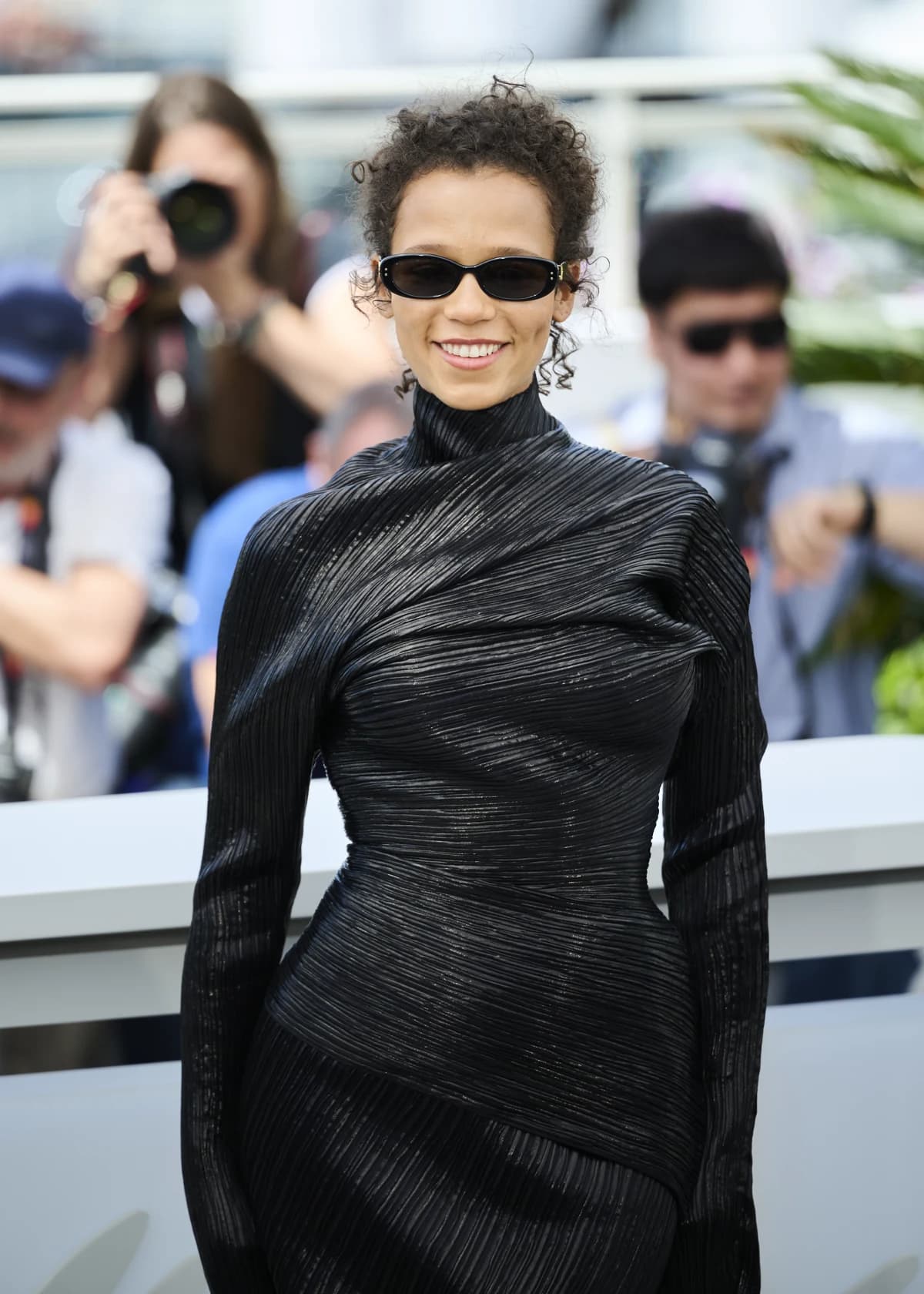
Taylor Russell’s assignment in HOPE included making her expressions bigger. In a Cannes interview with Vogue France, she described Na Hong-jin asking for more exaggerated facial performance for digital capture. A recognizable face was only the starting material. (Vogue France)
Spoilers: this profile identifies Russell’s nonhuman character and discusses performance preparation. It does not reveal the ending. The linked interviews contain further story details.
Ai’dovor requires a different kind of physical freedom
The Cannes cast list credits Russell as Ai’dovor. That is the official spelling used here; interview translations render the name differently. (Cannes)
In Dispatch’s Cannes interview, Ai’dovor is described as an attendant to Alicia Vikander’s empress, J’aur. Russell discussed the difficulty of matching an agile, animalistic creature’s movement while wearing capture equipment. She also found room to experiment because creature performance did not offer a single correct model to copy. (Dispatch)
Our reading is that this creates a very practical acting problem. The equipment belongs to the performer’s present circumstances; the freedom of movement belongs to the fictional body. Making those two things meet is work, even when the finished character does not resemble an ordinary photograph of the actor.
That is a more useful reason to follow Russell’s contribution than treating a cast announcement as a promise of extensive screen time. It directs attention toward how the performance was made.
A late arrival on a set that still had energy
Russell told StarNews, in a May 18 interview published two days later, that she joined the later stage of filming. She recalled a welcoming Korean crew and considerable energy despite the production being near its end. (StarNews, Korean original)
She also described uncertainty when first offered the part: she did not know how the alien would look or how her work would turn out. Wanting to work with Na helped her commit. She had watched his three earlier features, including The Wailing, and the completed film exceeded what she had imagined. (Same interview)
Her account separates two experiences that publicity can compress into one: agreeing to a role and discovering its final form. For a digitally constructed character, the audience’s first impression arrives after decisions made across performance and post-production. Russell’s initial uncertainty should not be turned into a claim that she lacked preparation.
Venice provides a career marker, not an acting formula
Before HOPE’s Cannes appearance, Russell won the Marcello Mastroianni Award for Best Young Actor or Actress at the 2022 Venice Film Festival for Bones and All, directed by Luca Guadagnino. Venice’s official awards record establishes that milestone precisely. (La Biennale)
The connection is a career comparison: an actor already recognized at a major festival takes on another director’s unusual assignment. The award does not explain why Na cast her, and it does not tell us which earlier techniques she brought to Ai’dovor.
For viewers following Russell between the two films, the interesting question is how a performer adapts to the conditions of a new role. Here, her own account points to movement and the scale of expression. That is firmer ground than announcing a permanent career reinvention on the strength of one film.
Keep the size of the role in perspective
Dispatch’s interview addresses the international actors’ brief screen presence. An exact running-time breakdown for Russell has not been verified here. Her name in the ensemble should not be mistaken for a guarantee that Ai’dovor carries the film’s central viewpoint. (Dispatch)
For the wider premise and official trailer, read our HOPE film guide. The Na Hong-jin profile follows his larger body of work. Russell’s contribution offers a smaller, concrete point of entry: the effort involved in making an unfamiliar body feel capable of moving for itself.