Jongmyo (종묘) is Seoul’s royal ancestral shrine: a place for honoring deceased Joseon kings and queens, rather than a palace where the royal household lived. That distinction changes what to look for. Its halls, open ritual spaces and supporting buildings make more sense as a setting for remembrance than as a sequence of royal living quarters.
For an international visitor, the useful question is not simply whether Jongmyo resembles a palace. It is what the buildings were meant to make possible—and why the ceremonies associated with them still matter.
Ancestral tablets, rather than a royal residence
UNESCO’s account of Jongmyo identifies it as the home of spirit tablets for former kings and queens. The king participated in rites associated with the well-being of the state and its people. Remembering ancestors also affirmed the royal family’s legitimacy.
Think of three different functions when comparing royal sites: a palace belongs to the world of residence and government; a tomb is a burial place; Jongmyo is a shrine organized around ancestral rites. Visiting one does not explain away the others. They answer different questions about how a dynasty represented itself.
The complex was first built in the late fourteenth century. It was destroyed during the sixteenth-century Japanese invasions and rebuilt in the early seventeenth century, with later expansions. A historic site can therefore preserve a longstanding ritual purpose without every timber dating to its foundation.
Read the long hall together with its courtyard
Jeongjeon is the main shrine, while Yeongnyeongjeon is the auxiliary shrine. Their names identify different parts of the complex, not alternative names for Jongmyo as a whole.
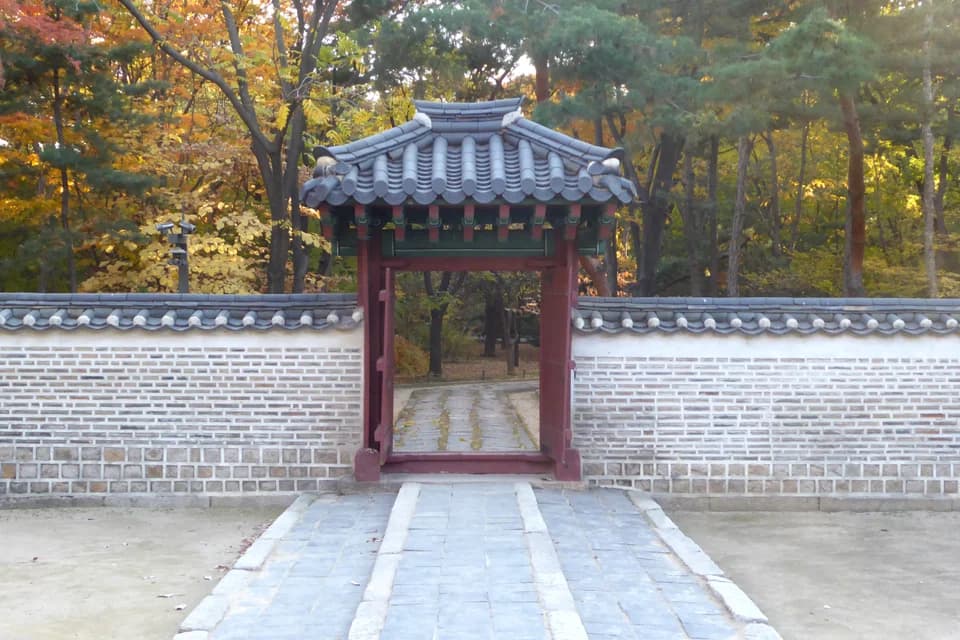
Supporting spaces matter too. UNESCO identifies Jaegung as a place where the king and other participants waited for the rites. A photograph of its enclosure entrance illustrates that supporting architecture; it should not be mistaken for a view of Jeongjeon’s main facade.
The Korea Tourism Organization’s heritage guide draws attention to Jeongjeon’s long wooden frontage and its relationship with the courtyard. Rather than searching only for decorative detail, look at the repetition of columns, the length of the roofline and the space in front of the building. This is an architectural reading of a ritual setting, not a claim that every open area is available to visitors.
The same guide explains that different gates served different ceremonial roles, including a route reserved for royal spirits. A path’s central position does not automatically make it the visitor route. Follow on-site signs and staff instructions instead of treating the complex as an unrestricted shortcut.
Jerye is the rite; Jeryeak is its music
Two similar-looking terms often appear in descriptions of Jongmyo. Jongmyo Jerye refers to the ancestral ritual. Jongmyo Jeryeak refers to the associated ritual music.
The Korea Tourism Organization’s intangible-heritage introduction describes formally dressed officiants preparing food and alcohol for the ancestors. Music follows the ritual’s order. Understanding this relationship helps explain why Jongmyo is discussed as both a built place and a continuing cultural practice.
A photograph of an empty courtyard can explain the architecture. It cannot show the full ceremony, or establish that a performance will take place during your visit. Check an official event notice separately if seeing a rite or performance is your main purpose.
Plan a shrine visit separately from a palace visit
Use the official visitor listing and the heritage operator’s linked notices to confirm admission arrangements, opening hours and closures for your chosen date. These operational details can change independently of the site’s historical meaning.
If you are choosing what to see, Jongmyo offers a focused way to understand royal ancestor veneration. A nearby palace can complement that visit, but its ticket, entry arrangements and spaces should be checked separately. Decide whether you want to study the architecture or attend a particular ceremony before setting your itinerary.
Sources & Reporting
KSPILL checked UNESCO and Korea Tourism Organization material on September 10, 2026. This article explains the shrine’s purpose, architecture and ritual vocabulary; it does not advertise a scheduled performance or guarantee current access to any hall. Any architectural photograph accompanying it should be read with its capture date and caption, not as evidence of today’s visitor conditions.
Architectural photograph: Entrance Doorway to the Jaegung Enclosure, Jongmyo, Ethan Doyle White, November 8, 2019, CC BY-SA 4.0. Resized and converted to WebP; the photograph remains under the same license.