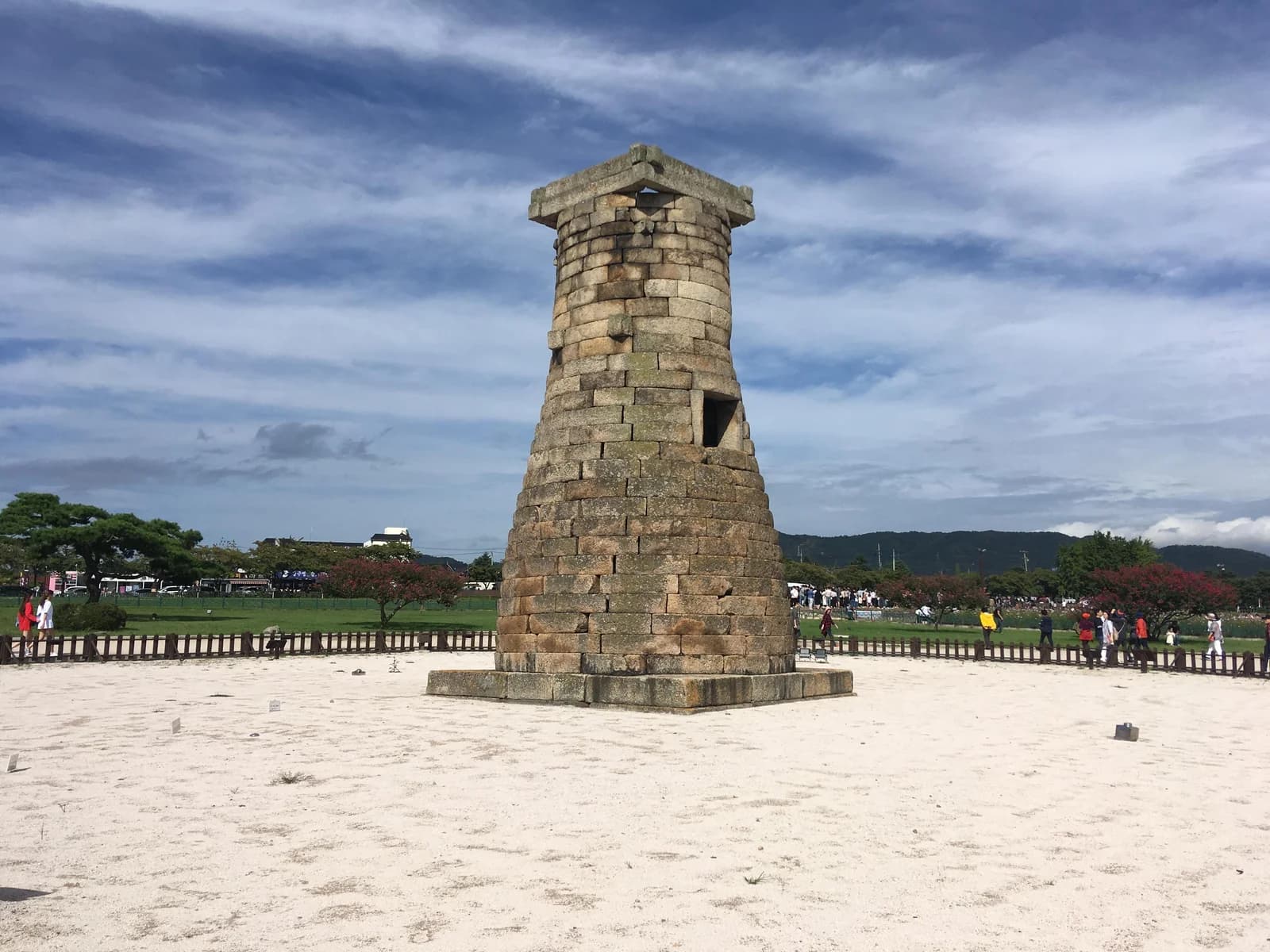
At Cheomseongdae (첨성대) in Gyeongju, the landmark is a stone tower standing in an open landscape. It is roughly nine meters high, according to the Korea Tourism Organization. Its scale invites a close look: the curved sides, stacked blocks and square opening are easier to take in than a distant skyline monument.
Archive photograph: Cheomseongdae in 2018.jpg by Christophe95, CC BY-SA 4.0. 2018 archive view of the actual monument. Shows its full form and opening; does not establish how astronomical observations were performed. Resized and converted to WebP. The photograph remains under CC BY-SA 4.0.
Place it in Silla’s time
The official tourism introduction places Cheomseongdae in the reign of Queen Seondeok, 632–647, during the Silla period. The Korea Heritage Agency’s heritage route likewise associates its construction with her reign and presents it as an important surviving astronomical monument.
That seventh-century setting matters more to a first visit than a contest over superlatives. The tower belongs to a much earlier world than the modern telescope observatory an English-speaking visitor might initially picture. Its survival lets you look at an actual structure connected with that history.
Three details to notice from outside
Begin at the base, where the tower meets its stone platform. Follow the changing outline upward: the body narrows before reaching the projecting stones at the top. Then find the square opening in the side.
These are visible features in the photograph, not a reconstruction of an observer at work. The opening naturally raises questions about access and use, but the image alone cannot answer them. It is better to keep the observable structure separate from an imagined sequence of climbing, setting up instruments and watching stars.
The same care applies to numbers. A count of stone courses can be interesting, but a proposed symbolic meaning is an additional interpretation. You can appreciate the masonry without treating every numerical explanation as an established construction instruction.
Put the tower back into the landscape
Gyeongju City includes Cheomseongdae in a walking course through the historic center. Its guide places Daereungwon, Cheomseongdae, Donggung and Wolji within a compact area. That makes the tower a useful part of a heritage walk, rather than an isolated stop for a photograph.
Compare what each stop asks you to notice. At the tower, the interest is concentrated in one stone structure and its setting. Around the ancient tombs, the landforms become the focus. The contrast helps keep the different kinds of heritage from blending into a single idea of “old Gyeongju.”
For a visit, check the linked city and tourism pages for current access information. Their route estimates do not include all the time you might spend looking around. Leave room to pause at the tower and examine the details that a quick distant photo can miss.