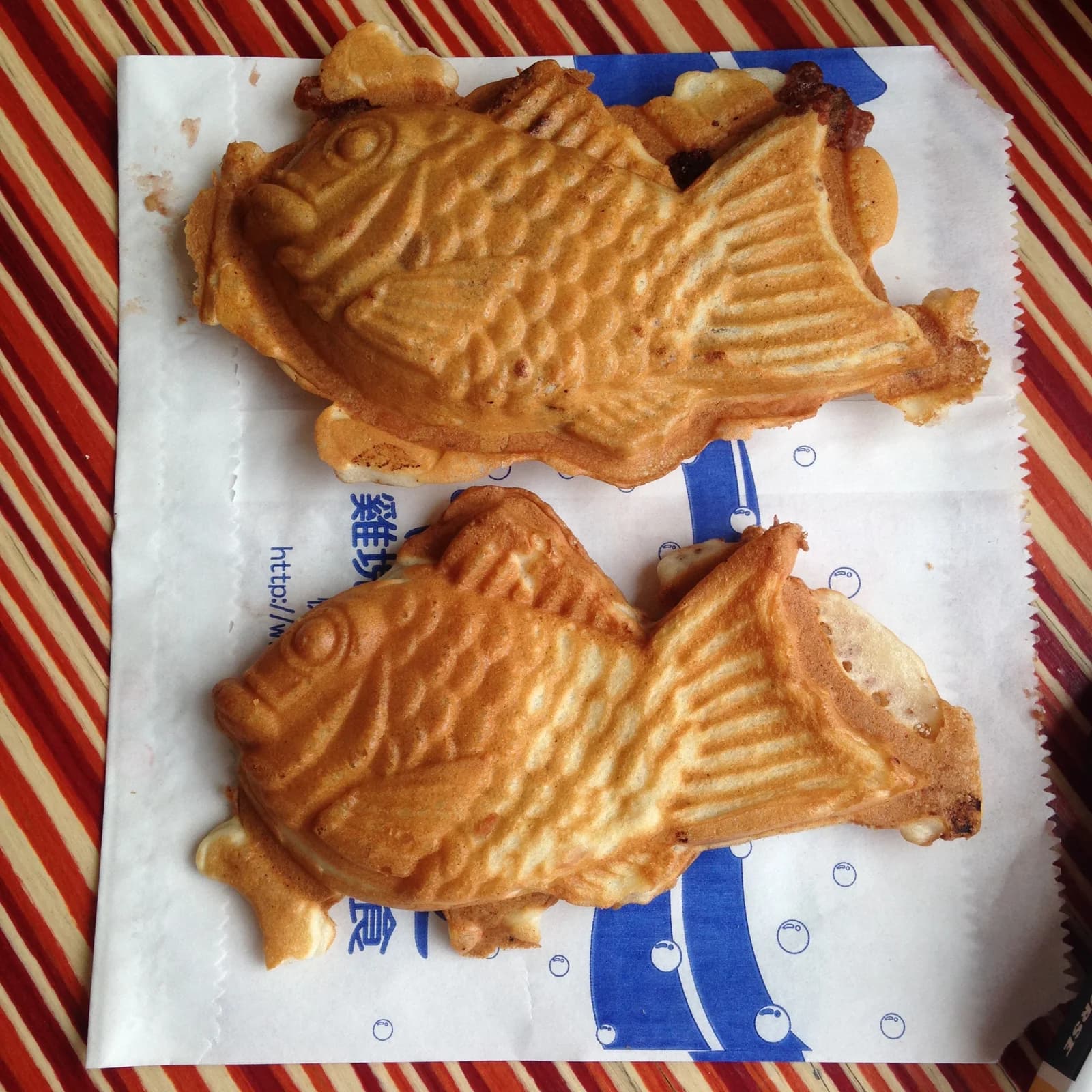
The scales and tail are the first things you notice. Bungeoppang (붕어빵) is a Korean bun baked in a fish-shaped mold, commonly with sweet red bean filling. Its outline tells you how it was shaped; it does not mean that the familiar sweet version contains fish.
Archive photograph: Boong o bbang.jpg by Penny Richards, CC BY-SA 4.0. 2017 archive photograph at a boba shop in Gardena, California, United States. Illustrates the recognizable food shape, not a Korean street stall. Filling is not visible. Resized and converted to WebP. The photograph remains under CC BY-SA 4.0.
What the mold gives you
The Korea Tourism Organization’s food guide describes a flour-based bun with a crisp exterior and a softer interior around the filling. The mold gives it the recognizable body, scales and tail. Those details make the snack identifiable before it is cut open.
The photograph is especially useful for that first encounter. You can follow the fins and the edge where the shaped shell ends. You cannot see the center, so the picture should not be treated as evidence of which filling these particular buns contain.
Red bean is common; the center can change
Sweet red bean paste is the familiar choice. Custard cream, chocolate and cheese versions also appear in the tourism organization’s description. This is why identifying the fish shape is only the first step when ordering.
Check which filling the seller offers before choosing. If a menu shows several nearly identical fish, the difference may be inside. Asking about the filling is more useful than assuming that every fish-shaped bun tastes the same. The category also does not establish a complete ingredient list for a particular shop’s batter or filling.
Why bungeoppang appears in winter conversations
The Korea Tourism Organization groups bungeoppang and hotteok among snacks associated with winter. A warm, filled snack has an obvious appeal when the air is cold. The seasonal association helps explain why a reference to bungeoppang can evoke more than the food’s shape.
That association is not a promise that every street has a stall, or that the snack is unavailable at other times. The archive image here was taken in California, which also shows why a photograph of bungeoppang cannot establish that a scene is in Korea.
Bungeoppang or hotteok?
If both names appear on a menu, begin with their different forms. Bungeoppang has its molded fish shell. Hotteok is a filled pancake; the tourism guide describes brown sugar, cinnamon and nuts forming a syrupy center as it cooks.
The practical question is which filling and texture you want. Neither name is a guarantee that all vendors use the same recipe. Once you have identified the snack and checked its filling, you can enjoy the fish shape for what it is: a memorable way of presenting a small bun.