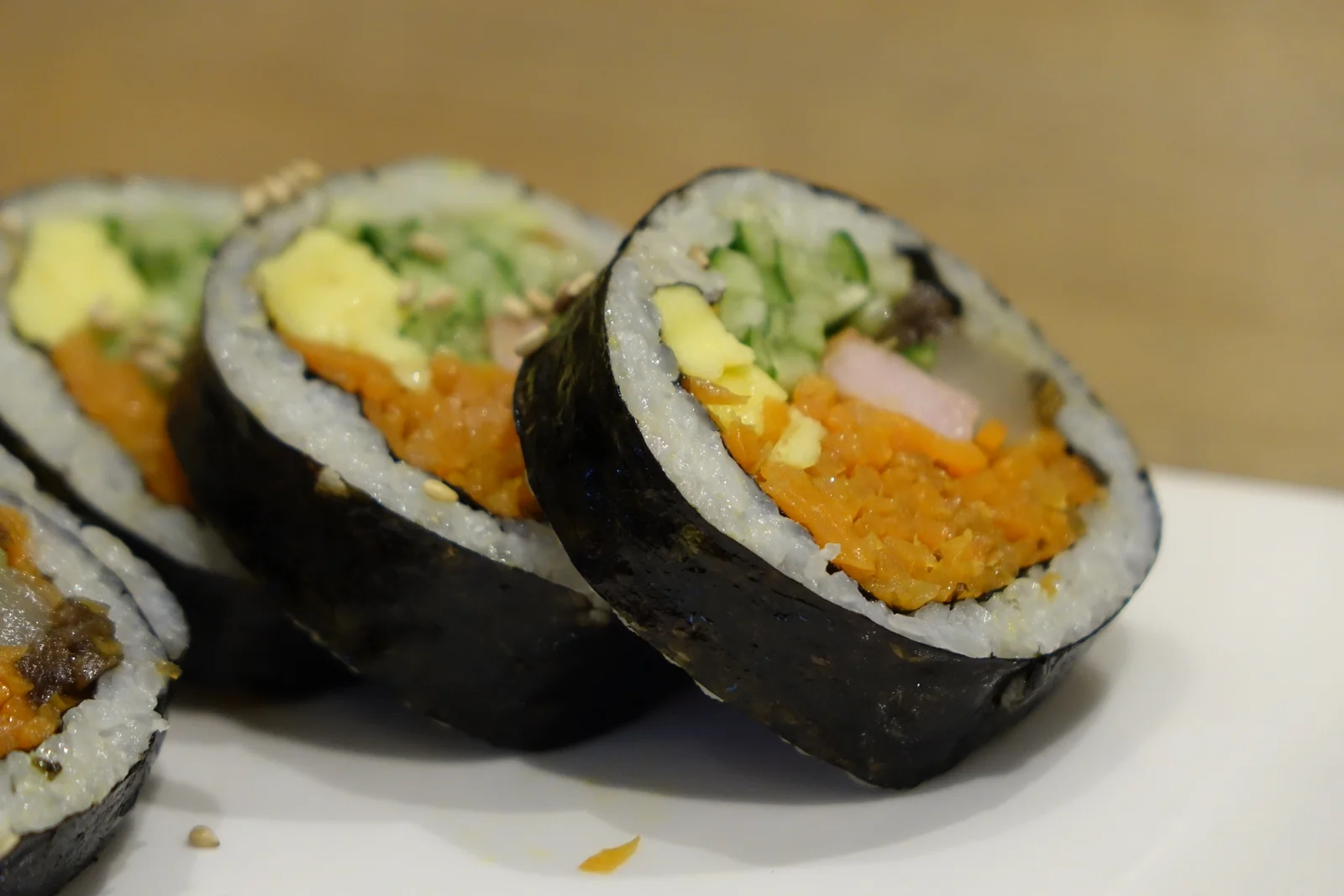
The cut face of gimbap (김밥) is a useful introduction: dark seaweed around the outside, rice inside it, and a cluster of fillings in the middle. The name combines gim, dried seaweed, and bap, cooked rice. This Korean roll can carry several ingredients in one small piece, which helps explain its place in picnic lunches and everyday meals.
Archive photograph: 2015년 3월 8일 당근이 많이 들어간 김밥.jpg by 최광모, CC BY-SA 4.0. 2015 archive close-up: visible rice, seaweed and fillings explain the roll structure. The photograph cannot establish every ingredient. Resized and converted to WebP. The photograph remains under CC BY-SA 4.0.
Read the roll from the outside in
The seaweed holds the roll together. Rice forms a layer around fillings such as carrot, spinach, egg and pickled radish; ham is another familiar addition. The Korea Tourism Organization describes this assembly in its guide to gimbap variations.
Look at the photograph and the construction becomes easier to follow. Each slice exposes the same long ingredients from a different point along the roll. That visible pattern explains the format, but it cannot identify every ingredient or seasoning in the food pictured.
The rice matters as much as the shape
Calling gimbap “Korean sushi” offers a quick visual comparison, but leaves out a useful difference. In Maangchi’s classic recipe, the rice is seasoned with salt and sesame oil. Her method illustrates the savory seasoning associated with gimbap, rather than the vinegared rice of sushi.
Her version combines beef, spinach, carrot, egg and pickled radish. It is one cook’s preparation, not a rule that every shop must follow. If you want to make the dish, use a complete recipe rather than trying to reconstruct it from a photograph: the seasoning and preparation of each filling matter even when they disappear inside the roll.
A filling name is a starting point
The tourism organization also documents rolls built around tuna, aged kimchi or pork belly. This variety makes the menu useful, but a highlighted filling is not a complete ingredient list. A tuna roll may contain other ingredients as well.
For a first order, choose the filling that interests you and ask about anything you need to avoid. A colorful vegetable-filled cross-section does not, by itself, establish that a roll is vegetarian. Nor does the seaweed wrapper mean that the center must contain raw fish.
Chungmu gimbap changes where the flavor sits
There is a particularly helpful exception to the filled-roll picture. Chungmu gimbap, associated with Tongyeong, pairs small rolls of plain rice and seaweed with spicy radish kimchi and seasoned squid served separately. The official food entry explains that arrangement.
Here, the accompaniments do work that fillings perform in a larger roll. When this version arrives, the apparently plain rice is intentional. Looking at the whole plate, rather than only the roll, tells you how the meal fits together.