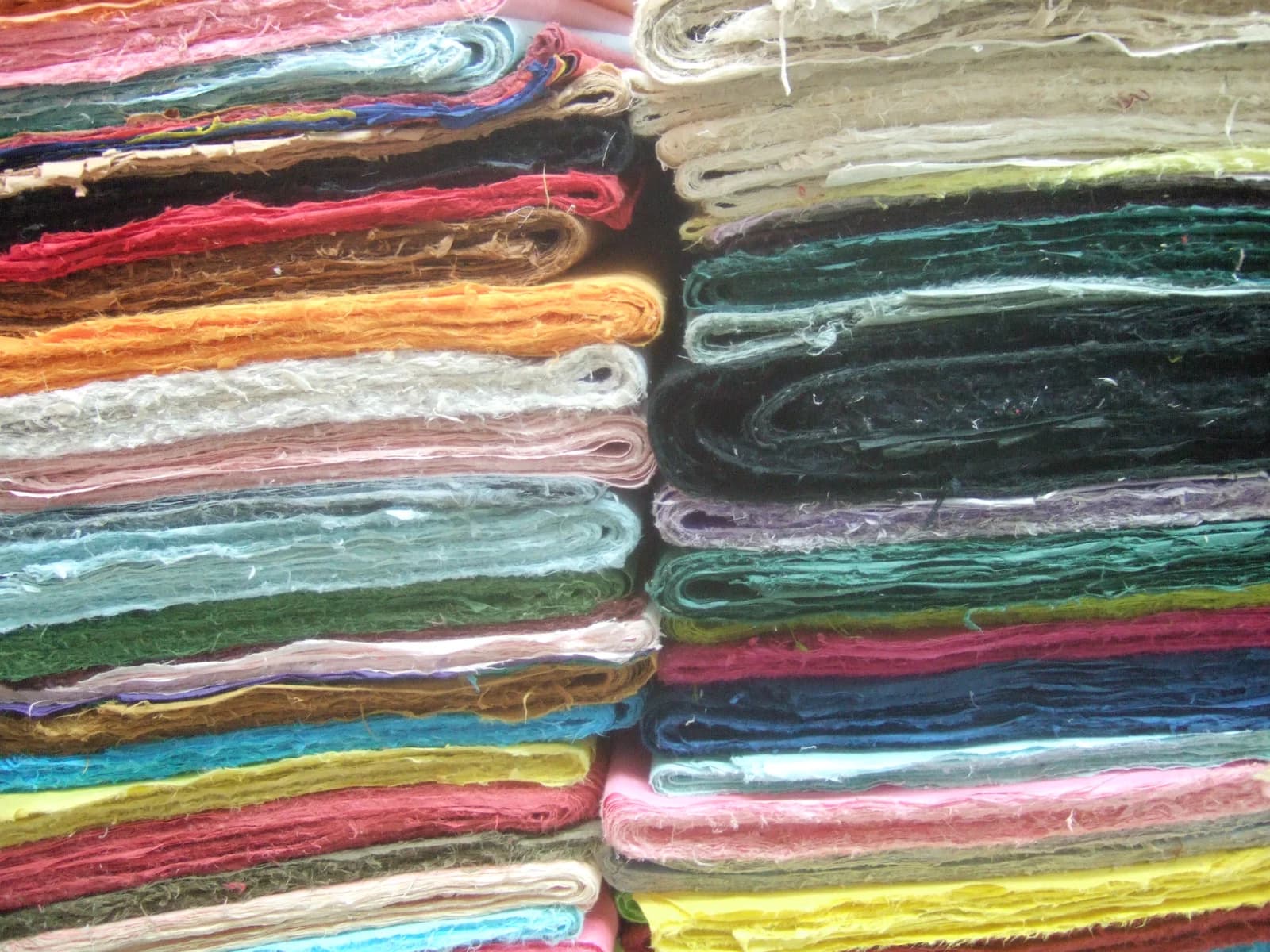
Those colorful stacks could almost pass for folded fabric. Look closer at the photograph: the edges reveal the fibers of handmade paper. Hanji (한지) is traditional Korean paper made primarily from the bark fibers of the dak, or paper mulberry, tree. A finished sheet hides a surprising amount of work.
Archive photo: Seoul-Insadong-Papers by jared, 13 November 2006, CC BY 2.0. Resized and converted to WebP. This shop photograph shows paper sheets, not a papermaking demonstration or current stock.
From bark to a sheet of hanji
Turning bark into paper takes several stages. Korea’s delegation to UNESCO describes harvesting, steaming, peeling and pounding, followed by forming and drying sheets. The finished material depends on knowledge carried through that sequence, well before anyone writes on it. Official hanji introduction
The Jordan Schnitzer Museum of Art gives a useful picture of sheet formation: mulberry fibers are suspended in water and collected through a woven bamboo tray. The artisan is shaping loose fibers into the surface that will become paper. That helps make sense of the photograph’s fibrous edges, although a photograph alone cannot establish a sheet’s exact recipe.
Why ink and paper belong in the same story
The National Institute of Korean History describes hanji as durable and resistant to tearing, with a surface suited to ink. Its account places papermaking alongside printing: recording knowledge required a material on which words could survive and circulate. Papermaking and Printing Techniques
For an overseas reader, this is a useful shift in attention. In a book or painting, the writing and image tend to get the credit. The paper has a job, too. Durability is a characteristic of the tradition, however, rather than a guarantee that every modern product labeled hanji will last for centuries.
The paper can become part of the artwork
Hanji also gives artists something to work with beyond a flat writing surface. The museum’s Fluid Continuity guide includes a nineteenth-century folding screen built with layers of Korean paper, as well as contemporary works using the material.
For his Aggregation series, Chun Kwang Young wraps small forms with paper from older printed materials and assembles them into larger compositions. Paper becomes a visible component of the work, carrying traces of text with it. Museum guide, Korean Paper section
There is a human story behind the sheet as well. Korea’s delegation highlights pumasi, reciprocal community labor involved in preparing materials and making hanji. Knowing that changes the question from “What can I make with this?” to “What work made this possible?” A sheet is the result of that work before it becomes somebody else’s book, image or object.