Photo: Huntsmanleader — Dancheong at Changgyeonggung 2023-11-02. Archive photograph; resized without cropping and converted to WebP under CC BY 4.0.
Look up before walking through a Korean palace gate. The wood above you may carry stripes, flower-like shapes and repeated bands of color. That painted surface has a name: dancheong (단청).
Dancheong is traditional decorative painting on wooden buildings and objects. On a building, it helps turn the structure itself into something to read: follow a beam, find a repeated pattern, then notice where the painter lets the background breathe.
Start with the timber, then the color
Dancheong belongs to the finishing of a wooden building. The Architecture and Urban Research Institute describes finishing as a protective coating against decay and pests, distinguishing painted temple and palace timber from oil finishes used in ordinary houses. Beauty and maintenance share the same surface. AURI’s building guide, p.184
That does not mean every traditionally built Korean house needs elaborate paint. Nor does an unpainted beam mean its decoration is missing. The building’s use matters when interpreting its finish.
Five basic colors, many ways to arrange them
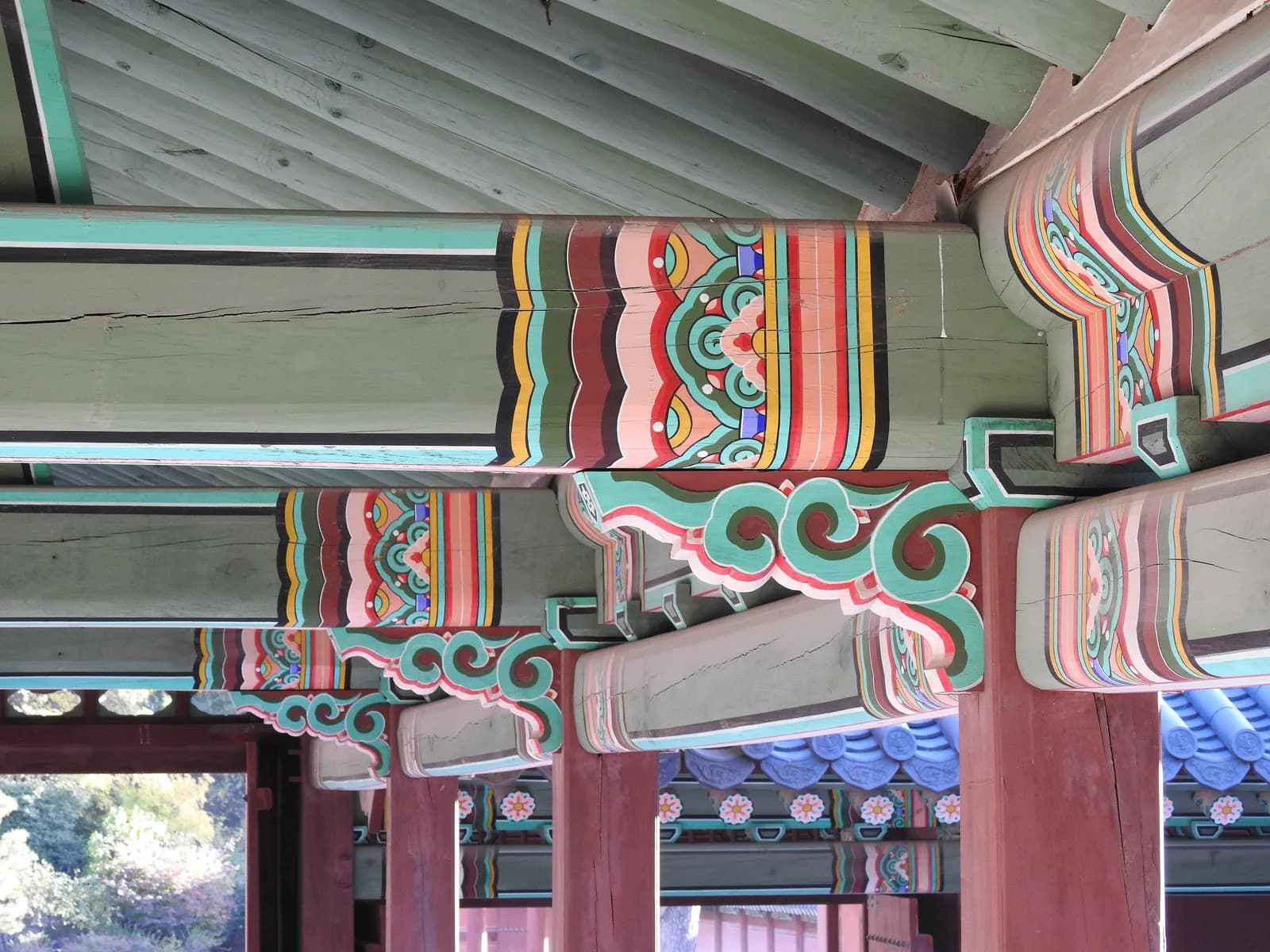
The traditional palette centers on blue, red, yellow, white and black. But spotting five colors is only a beginning. AURI also describes plain-color dancheong, called gachil-dancheong, alongside symbolic lines and lotus patterns.
In more elaborate work, contrast helps separate neighboring shapes. The Korean Culture and Information Service’s guide describes alternating warm and cool colors and using white lines to make outlines distinct. It also distinguishes repeating geometric designs from individually placed motifs. Guide to Korean Culture
Try following just one painted edge. You may notice an order that disappears when the entire ceiling is treated as a single colorful backdrop.
The craft includes the person painting
Dancheongjang (단청장) can name the painting skill or a practitioner, according to Daegu Nam-gu’s heritage description. The finished patterns are evidence of trained work, not simply a palette anyone applies at random. Nam-gu’s craft description
The cultural guide describes a head artisan selecting a building’s painting scheme and supervising the work. Looking at the result can therefore be a way to notice decisions: which members receive strong patterns, which stay quieter, and how the parts fit together.
A closer look at the photograph
The archive photograph above shows painted beams at Changgyeonggung in November 2023. Green fields, outlined stripes and curved details remain legible against the timber. It illustrates architectural paintwork; it does not establish when those particular surfaces were painted or their present condition.
On your next palace or temple visit, choose one beam before photographing the whole roof. Dancheong becomes easier to see when you give its smaller decisions a moment.