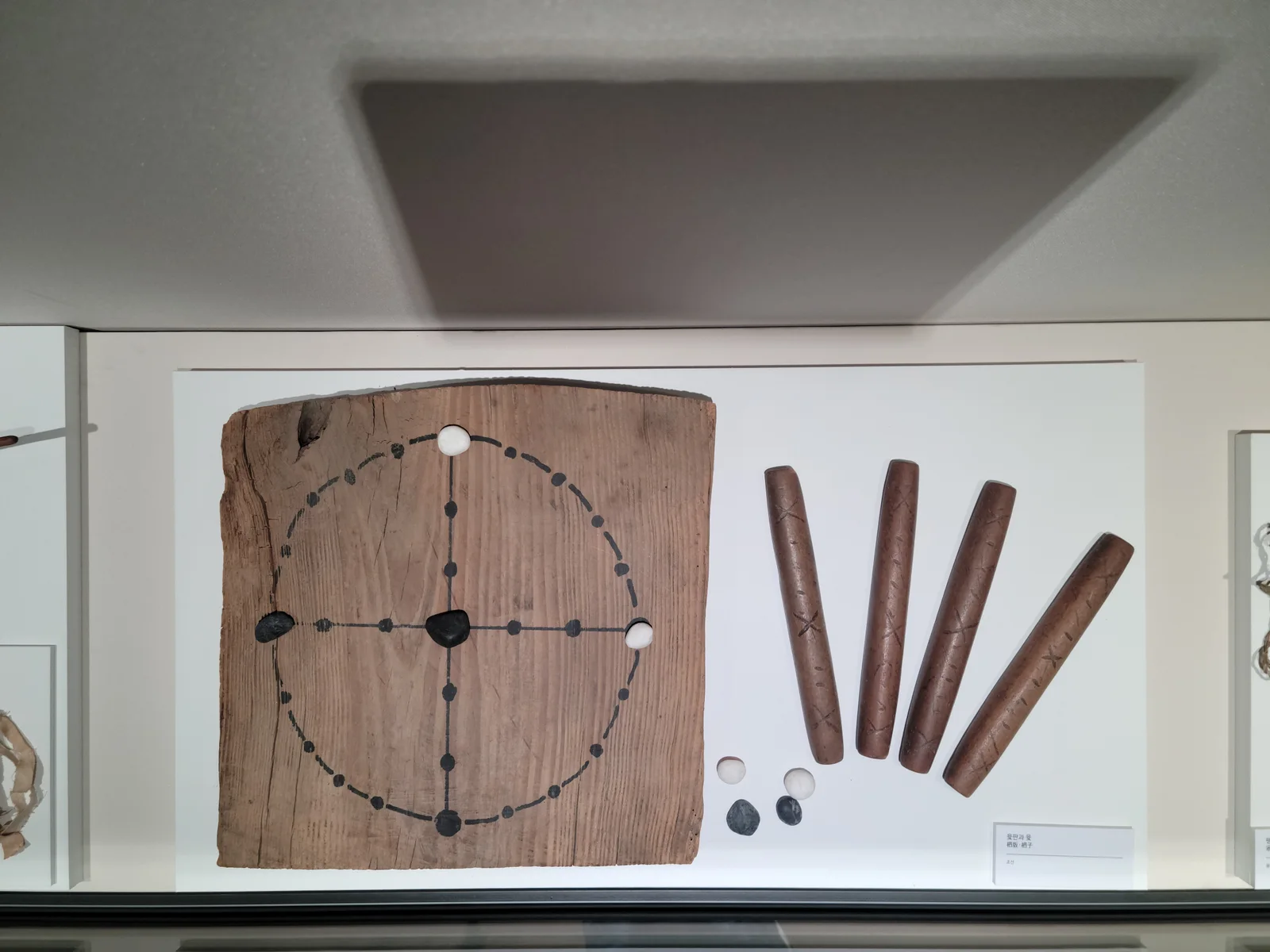
Yutnori (윷놀이) is a Korean folk board game in which players throw four wooden sticks—not dice—and race four tokens around a distinctive board. The first player or team to bring all four tokens home wins. It is especially associated with Seollal, Korea’s Lunar New Year holiday, when relatives and friends can gather around one board regardless of age.
The game is quick to learn, but its choices make it unexpectedly tactical: take a shortcut, protect a token, stack tokens together, or risk losing them all to an opponent.
Start with the objects: yut sticks, tokens, and the yut board
A basic set has three parts.
- Yut (윷) or yutgarak (윷가락): four wooden sticks, traditionally made by splitting rounded pieces of wood lengthwise. Each stick has a flatter face and a rounded face.
- Yutmal (윷말): playing tokens. Each player or team normally has four.
- Yutpan (윷판): the board, whose dots are called bat (밭)—literally “fields.” A traditional board has 29 marked spaces, with an outer route and diagonal routes that meet at the center.
For a first-time player, the board may look like a square with an X drawn through it. That X is not decoration: it creates shorter routes. Landing exactly on certain corner spaces lets a token turn inward and travel along a diagonal, rather than continuing around the long outer path.
The five throws: do, gae, geol, yut, and mo
Throw all four sticks together, then read the combination of their two faces. The result determines how many spaces a token moves.
| Korean result | Move | Easy memory aid |
|---|---|---|
| Do (도) | 1 space | one step |
| Gae (개) | 2 spaces | two steps |
| Geol (걸) | 3 spaces | three steps |
| Yut (윷) | 4 spaces + throw again | four steps |
| Mo (모) | 5 spaces + throw again | five steps |
The physical orientation used to identify the result can be confusing when you first see a set, because markings and the way a game set labels its faces can differ. The important point is to agree before starting which face is being counted, then use the five-result chart supplied with that set.
Two results create the biggest cheers: yut and mo. Both grant another throw, so one lucky turn can suddenly change the game.
How a round actually works
Players take turns throwing the sticks and moving one of their own tokens by the result. A token starts off the board, enters at the starting point, follows the route, and must complete its journey to exit at the finish.
The winning condition is simple: get all four of your team’s tokens through the finish before the other side does.
The strategy begins once more than one token is on the board.
- Take the diagonal only when you land on its entry space. You cannot turn onto a shortcut whenever you like.
- Land on your own token to combine them. This is called eopgi (업기), often explained as “carrying” or “stacking.” The joined tokens move together on later turns.
- Land exactly on an opponent’s token to capture it. The captured token returns to the start. In widely used rules, making a capture also earns another throw.
Stacking can speed up a team’s race because two or more tokens travel as one. But it is also risky: if an opponent captures that stack, every token in it goes back to the beginning.
Why the board is more than a race track
Yutnori combines chance and decision-making. The throw is unpredictable, but players choose which token to move, whether to send one token toward a shortcut, and whether to stack tokens or spread them out.
That is why a player who is behind can still make a comeback. A mo, a bonus throw, and a well-timed capture can reverse the board in a few seconds.
For visitors, a useful comparison is that yutnori has the accessible race-and-capture feeling of many family board games—but its four sticks, branching routes, and stacking rule give it a character of its own.
The animal names behind the results
A traditional interpretation connects the five result names with familiar animals: do with a pig, gae with a dog, geol with a sheep, yut with a cow, and mo with a horse. The sequence moves from one to five spaces.
This does not mean players need to think about animals while playing. Instead, it offers a glimpse of an older agricultural world in which domestic animals were closely tied to daily life, wealth, and movement. The exact linguistic history has been studied and debated, so it is best understood as a traditional scholarly interpretation rather than a single settled origin story.
A Lunar New Year game with older layers of meaning
Historically, yutnori was commonly played from Lunar New Year’s Day through Jeongwol Daeboreum (정월대보름), the first full moon of the lunar year. It was a family and village game, not a pastime limited to children.
Some historical interpretations connect yutnori with hopes or divination concerning the coming farming year. Another well-known Joseon-era reading sees the board as a model of the cosmos: the outer circle as heaven, the inner square as earth, and the marked points in relation to celestial patterns. These are interpretations of the game’s symbolism—not instructions needed to play a modern round.
South Korea recognized yutnori as a National Intangible Cultural Heritage in 2022. It was designated as a community tradition rather than something belonging to one named holder or group, reflecting how broadly it has been passed on and enjoyed.
One practical tip before you join a game
Ask the host which house rules are in play. Regional forms exist, including different sizes of sticks and versions such as jongji-yut (종지윷), played by shaking small sticks in a small bowl before tossing them out. Families may also differ on details such as how they handle particular routes or bonus throws.
That flexibility is part of yutnori’s appeal. Learn the shared basics—four sticks, five results, four tokens, shortcuts, stacking, and capturing—then follow the rules of the people around the board. When someone throws a mo, you will know why everyone suddenly leans in.