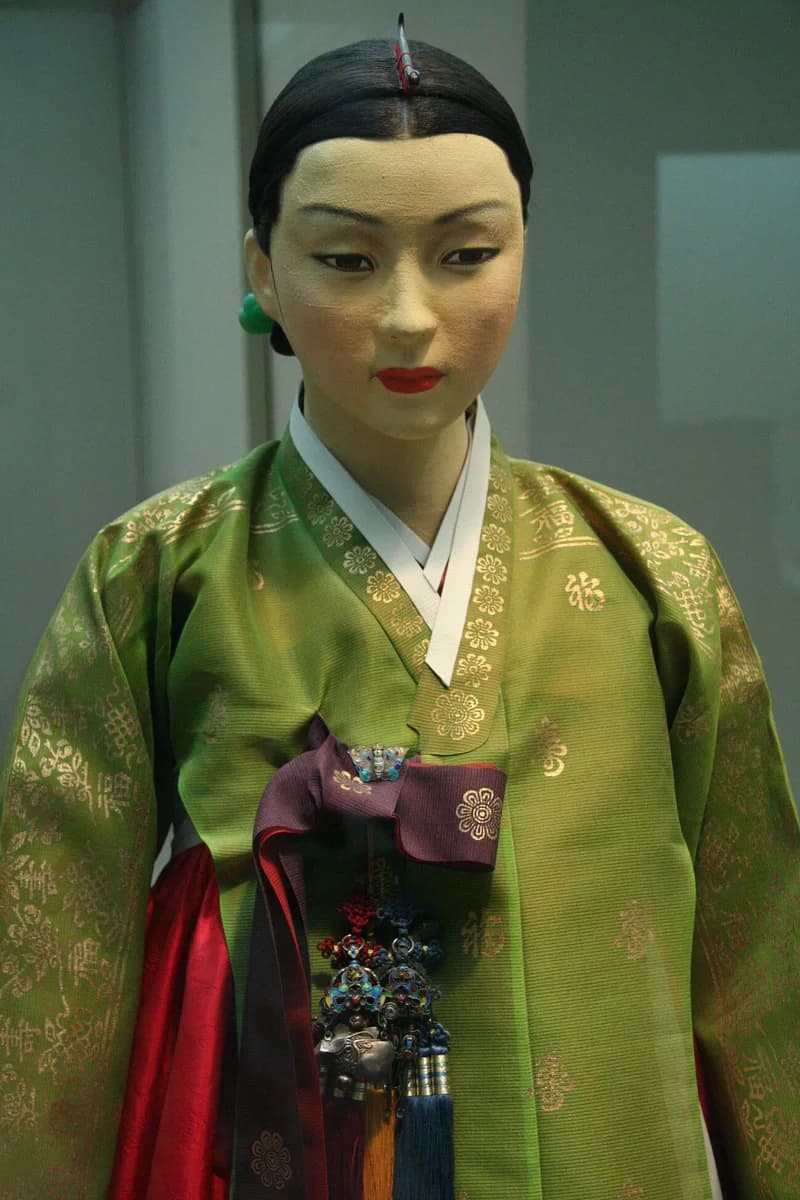
A norigae (노리개) is a traditional Korean hanging ornament worn with women’s hanbok. Rather than sitting flat on fabric like a brooch, it drops vertically from the jacket ribbons or skirt waistband: a small decorative centerpiece and ornate knots above, then a long silk tassel that moves as the wearer walks. In the Joseon period, norigae became one of the most developed forms of women’s adornment, adding colour, movement, craftsmanship, and auspicious wishes to an outfit. (encykorea.aks.ac.kr)
Picture a pendant with a long, soft tail
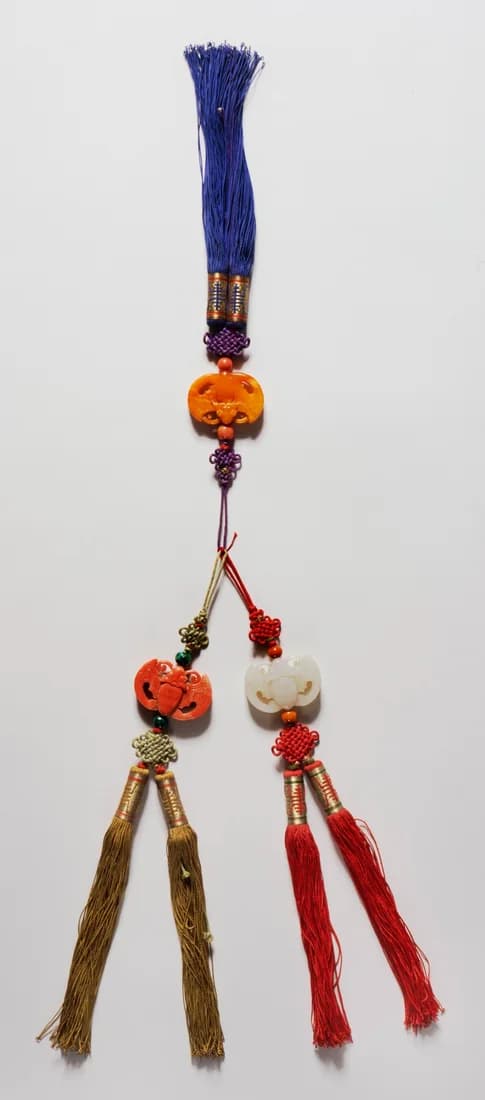
The easiest way to recognise a norigae is to look for its vertical silhouette. It is not one fixed design, but traditional examples usually have five connected elements:
- Ttidon (띠돈) — the small top loop or fitting that hooks onto clothing.
- Dahoe (다회) — a braided cord that links the parts.
- Paemul (패물) — the main ornamental object or pendant.
- Maedeup (매듭) — decorative Korean knots, often placed around the pendant.
- Sul (술) — the flowing tassel at the bottom.
From a distance, the tassel may look like a narrow waterfall of thread. Closer up, the object above it can be jade, coral, amber, metal, embroidered fabric, a tiny pouch, or a carved form such as a butterfly, bat, fish, gourd, peach, lock, or flower. Gold, silver, jade, amber, coral, pearls, silk, and coloured thread were among the materials used in historical pieces. (encykorea.aks.ac.kr)
How a norigae attaches to hanbok
Traditionally, a norigae is worn on the jeogori (저고리), the short hanbok jacket, or at the skirt waist. It is not normally pinned through the cloth.
For the jacket, first tie the goreum (고름), the two long front ribbons. Then place the norigae’s top loop over or through the tied ribbons so the ornament hangs down the front. The National Folk Museum of Korea notes that it may be worn from the outer ribbon, inner ribbon, or the skirt waist. When worn at the waist, it is threaded onto the skirt’s waist tie and allowed to fall over the skirt. (nfm.go.kr)
That placement is part of its design logic. A norigae’s compact knots sit near the short jacket, while its tassel extends over the long skirt. The accessory responds to the wearer’s stride rather than staying still, which is why it can make even a simple hanbok look more animated. (encykorea.aks.ac.kr)
A practical first-time rule
Hang the norigae after tying the jacket ribbons, and let it fall naturally rather than pulling it tight or forcing it into a central position. If you are renting hanbok, ask the rental staff where their specific piece is designed to sit; contemporary norigae-inspired accessories may use different fittings. Avoid piercing delicate silk or antique ornaments with a safety pin.
One pendant or three? 단작 and 삼작
A danjak norigae (단작노리개), also called an oejul or single-strand norigae, has one main pendant. It is the easiest form for a newcomer to identify: one hanging line, one focal ornament, one tassel.
A samjak norigae (삼작노리개) is a coordinated set of three pendants. The three parts may hang side by side from the same upper fitting, creating a broader and more elaborate display. Large daesamjak examples were especially associated with formal court dress, while smaller or single ornaments could suit less formal clothing. (encykorea.aks.ac.kr)
For a foreign visitor, a useful visual comparison is this: a danjak is like one carefully composed pendant; a samjak is like a small three-piece chandelier made for the front of a hanbok.
The motifs are wishes, not a universal secret code
Norigae motifs often carried auspicious meanings. They could express hopes for prosperity, long life, good fortune, harmony, or many descendants—values that appeared widely in Joseon-era decorative arts. Bats, for example, could signal good fortune; peaches and symbols linked to immortality could invoke longevity; flowers, fruit, paired birds, and certain characters could suggest prosperity or family happiness. (encykorea.aks.ac.kr)
But it is best not to treat every norigae motif as a rigid one-to-one code. Meaning depended on the material, pattern, occasion, and the person giving or wearing it. A lavish piece also communicated access to fine materials and skilled craft. Norigae could be valued possessions and were given in wedding preparations or passed through families as treasured items. (webzine.nfm.go.kr)
More than decoration: pouches, scent cases, and needle holders
Some norigae were functional as well as beautiful. Historical versions could incorporate a tiny scent case (hyanggap, 향갑), fragrance pouch, needle holder, or a small sheathed knife called a jangdo (장도). A scent case could hold fragrant material; a needle holder kept sewing needles close at hand. These objects became part of the ornament’s visual composition through cords, knots, and tassels. (encykorea.aks.ac.kr)
That detail changes how a norigae looks to modern eyes. What may seem like a purely decorative charm can actually be a miniature container or tool—an everyday object transformed into wearable craft.
Why norigae still makes hanbok feel complete
Hanbok is often recognised for its clean colour blocks, curved lines, and wide skirt silhouette. Norigae interrupts that broad surface with a concentrated flash of colour and texture: braided cord, carved material, precise knots, and tassel threads. In historical dress, it could make an outfit more formal, personal, or celebratory without changing the garment itself. (webzine.nfm.go.kr)
So when you see a norigae, look beyond the tassel. Notice where it hangs, what sits at its centre, and how it moves. It is a small object, but it brings together Korean knotting, textile work, jewellery, symbolic imagery, and the rhythm of hanbok in motion.