A kimchi refrigerator is not simply a second cold box filled with one side dish. It is an appliance built around the fact that kimchi keeps changing after it is packed.
Not every Korean household owns one, but in homes that store several containers or a large batch of 김장김치 (gimjang kimchi), dedicated space and tighter control can be valuable.
What You See: Another Refrigerator in the Kitchen
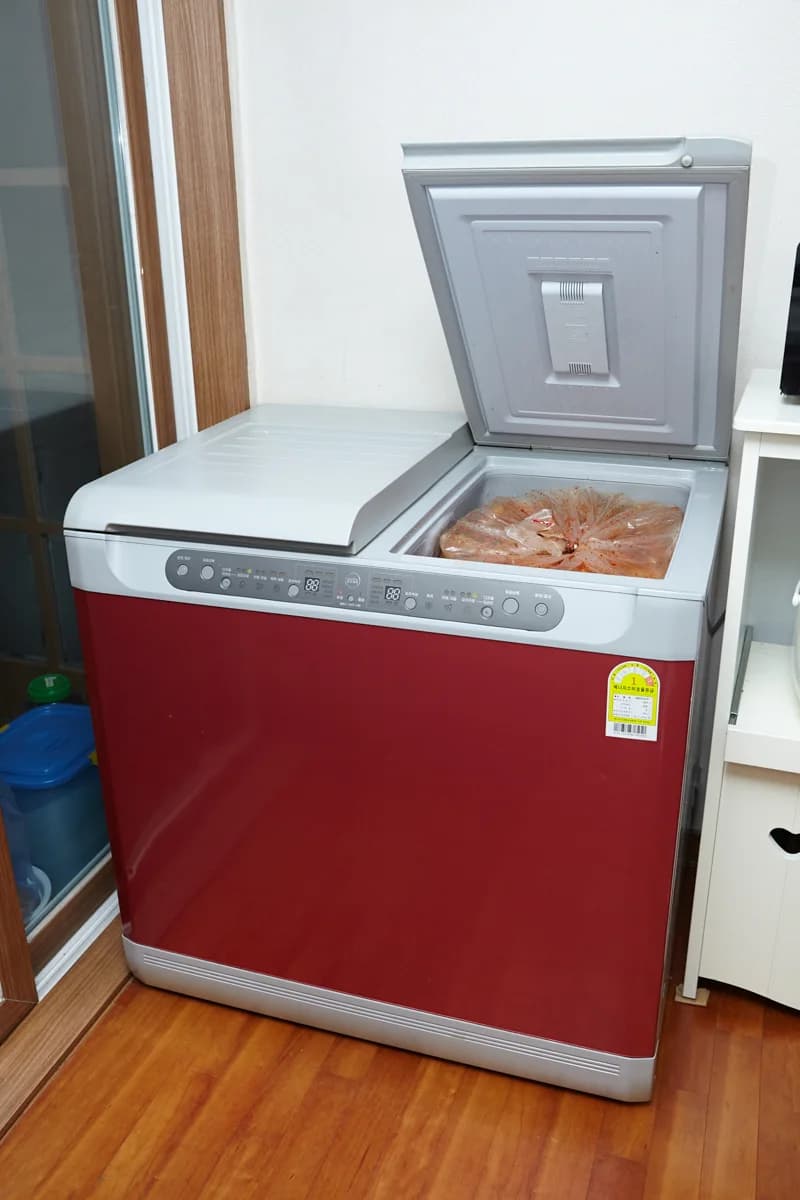
Kimchi refrigerators come in chest-style models with top-opening bins and upright models that resemble conventional refrigerators. Compartments can often be set independently for different kinds of kimchi or for other foods.
Inside are tightly lidded containers. They help reduce air exposure, leaks and odor transfer, while the appliance holds a storage mode chosen for the food in that compartment.
What Koreans May See: Fermentation That Needs Managing
The World Institute of Kimchi describes kimchi as a low-temperature fermented food whose flavor, aroma and texture continue to change as microorganisms grow and decline. Cooling does not make kimchi static; it helps manage the pace.
That is why “fresh,” “ripe,” “sour” and 묵은지 (mugeunji, long-aged kimchi) are not interchangeable failures or successes. Different dishes and households may prefer different stages.
How It Differs From an Ordinary Refrigerator
A standard refrigerator can safely store kimchi, especially in a sealed container. That is a modern contrast with traditional onggi fermentation jars, while a dedicated appliance adds specialized controls rather than making ordinary refrigeration impossible.
The World Institute of Kimchi's Kimchiology series describes fine temperature adjustment and cooling around storage compartments as defining features. LG's official guidance offers different cooling levels according to kimchi type and salt concentration, while Samsung lists separate low-temperature, room-temperature and variety-specific ripening modes on current models.
The practical advantage is consistency. A compartment can remain on a kimchi setting while the family refrigerator is opened repeatedly and adjusted for milk, vegetables, leftovers and drinks.
Why Separation Helps
Large containers consume shelf space. Fermentation can create distinctive aromas and gas, especially when lids or seals are imperfect. Keeping kimchi in a dedicated compartment reduces competition with delicate foods and makes it easier to organize several batches.
Separation is not a license to ignore food safety. Containers should not be overfilled, lids need to close correctly and manufacturer instructions matter. A refrigerator slows change; it does not rescue spoiled ingredients or an unsanitary batch.
From Winter Crocks to Temperature Controls
Kimchi was historically stored through winter in earthenware jars, sometimes buried to take advantage of relatively stable ground temperatures. Modern product names such as “underground fermentation” refer to that precedent, but an electronic refrigerator is a recent technology, not an unchanged ancient method.
It is better to say that the appliance solves a familiar cultural problem with modern engineering: how to keep a fermented staple at a useful stage for longer.
Does Every Korean Home Have One?
No. A small household may buy kimchi in modest quantities and use the main refrigerator. Studio residents may lack the floor space, and people who rarely eat kimchi have little reason to dedicate an appliance to it. Some owners also use spare compartments for produce, meat, grains or drinks when permitted by the model.
So the separate refrigerator does not prove that every meal revolves around kimchi. It shows how appliance design can become specialized when a widely eaten food is bulky, aromatic and still fermenting in storage.