Onggi (옹기) are traditional Korean earthenware vessels—most famously the large, round jars used to keep and ferment kimchi, doenjang (soybean paste), gochujang (red chili paste) and ganjang (soy sauce). They are called “breathing vessels” because their clay walls contain microscopic pores that allow a limited exchange of gases and moisture. The jar is not literally alive, but its material can help create a distinctive fermentation environment. (academic.oup.com)
First, picture the object
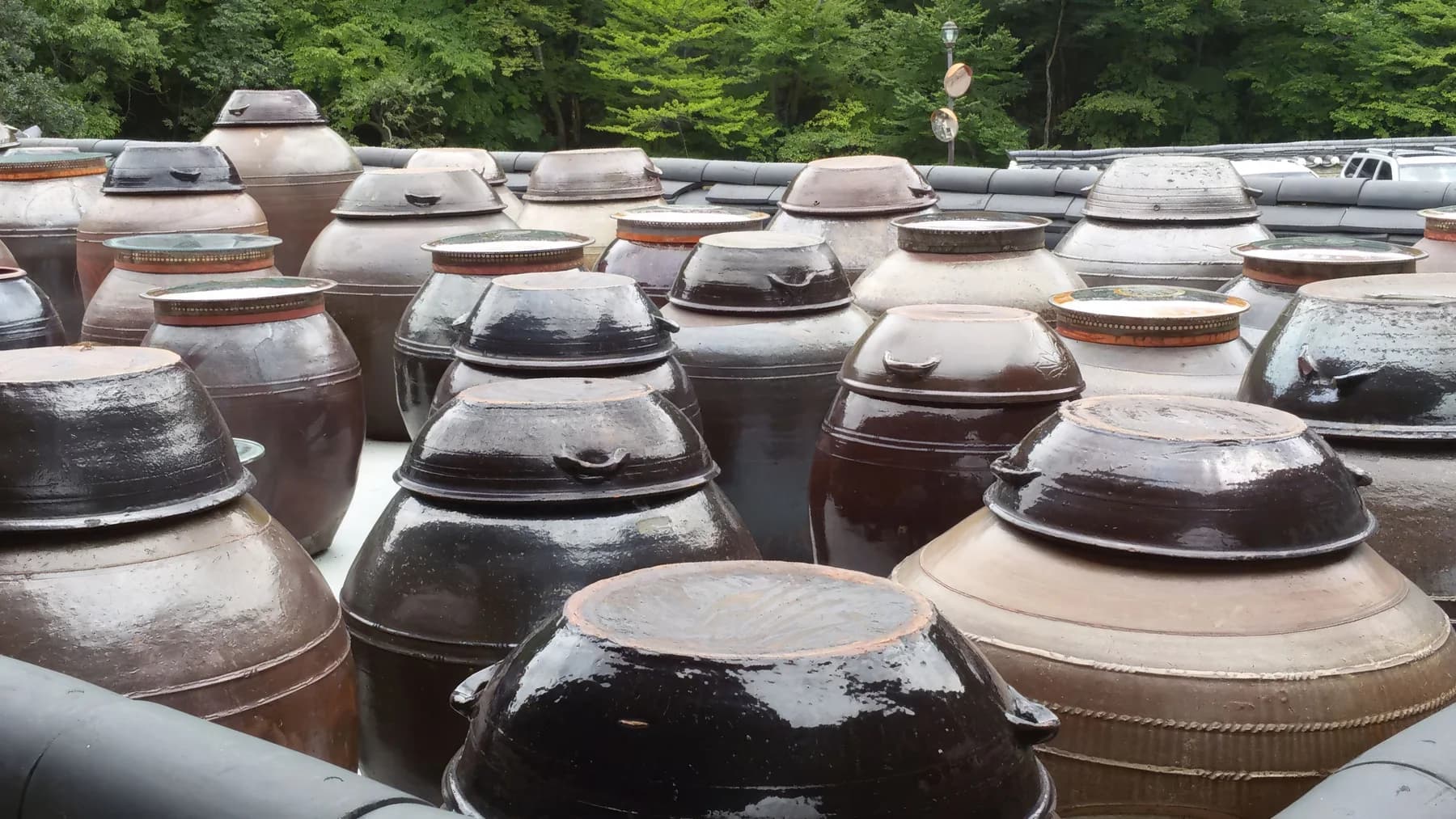
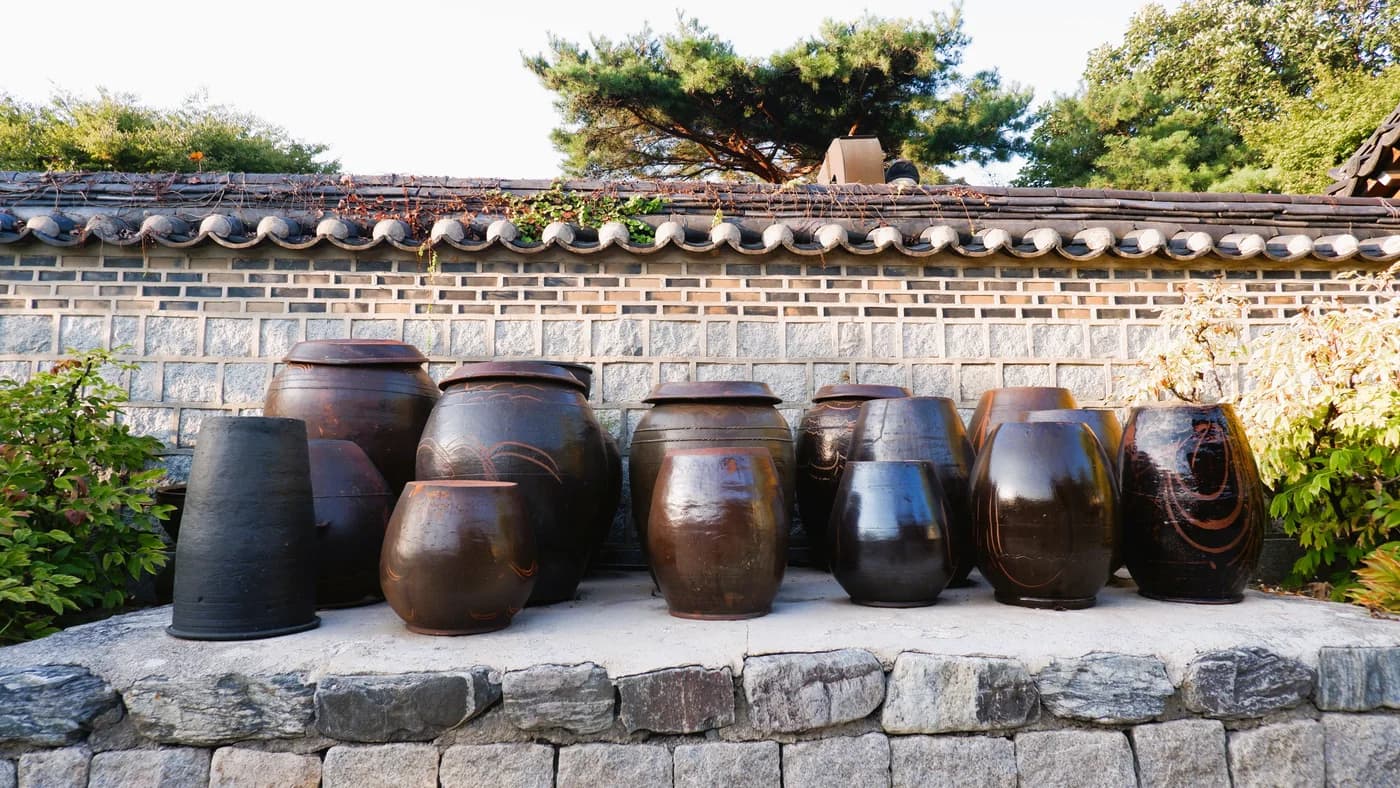
A classic storage onggi is generously rounded through the body, with a relatively narrow mouth and a separate lid. Its surface can look dark brown, black-brown or reddish-brown, often with subtle marks from hand-forming and firing. Large examples can feel almost architectural: a row of them turns a yard or terrace into a working pantry.
Onggi is not simply a decorative “kimchi pot.” It is a broad Korean tradition of earthenware making, recognized by the Korea Heritage Service as Onggijang, a traditional craft skill. Today, onggi can range from large fermentation jars to cups, bowls and contemporary household objects. (heritage.go.kr)
What “breathing” really means
The useful comparison is not a lung but a very slow membrane.
When clay is prepared and fired, its final structure can retain an interconnected network of minute pores. Research on onggi has measured permeability to oxygen, carbon dioxide and moisture. In a fermenting jar, that means some carbon dioxide produced inside can pass through the vessel wall, while small amounts of gases can move in the other direction. (academic.oup.com)
That is the science behind the poetic expression. An onggi does not open and close, actively regulate itself or make every food automatically better. Its permeability depends on details such as the clay body, wall thickness, firing and glaze treatment.
Why fermentation and onggi became closely linked
Korean cuisine includes many foods that transform gradually through salting, aging and microbial fermentation. Kimchi is one example, but the connection is equally strong with jang (장), the family of fermented soybean and chili condiments that includes doenjang, ganjang and gochujang.
For kimchi, controlled fermentation is central to flavor, acidity and texture. A study comparing containers found that onggi’s porous walls had relatively high gas permeability and could influence the conditions in which lactic acid bacteria grew. Another study found that carbon dioxide permeability can speed kimchi fermentation under its experimental conditions. These findings help explain why the vessel became so closely associated with fermented foods—but they should not be read as proof that every onggi always produces the “best” result. (academic.oup.com)
The cultural connection is visible in kimjang, the seasonal communal practice of making and sharing kimchi. UNESCO inscribed Kimjang in the Republic of Korea on its Representative List of the Intangible Cultural Heritage of Humanity in 2013. Historically, earthenware jars were part of the practical challenge of keeping large amounts of kimchi through colder months. (ich.unesco.org)
Porous does not mean unprotected
One common misunderstanding is that onggi is simply raw, unsealed clay. In reality, traditional and modern onggi can have different surface treatments, including glazing. That matters: experiments with soy sauce showed that changing the glazing changed water loss, salt concentration, gas movement and microbial activity during fermentation. (academic.oup.com)
In other words, “more breathing” is not automatically better. Too much permeability can mean greater moisture loss or too much oxygen exposure for a particular food. Onggi works as part of a whole system: the recipe, salinity, temperature, lid, storage time and particular vessel all matter.
An old jar in a modern food landscape
Plastic, glass and stainless-steel containers—and the modern kimchi refrigerator—are now common in Korean homes and commercial food production because they are convenient and easy to handle. Yet onggi remains meaningful as a craft tradition, a fermentation tool and a powerful visual symbol of Korean food culture.
For travelers who want to see the craft in context, Oegosan Onggi Village in Ulju-gun, Ulsan, is a major onggi-making destination, with artisans, a museum and hands-on experiences. The Korea Tourism Organization describes it as Korea’s largest village devoted to the craft. (english.visitkorea.or.kr)
If you want to use one at home
Treat an onggi as specialized food equipment, not as a magical shortcut. Buy from a maker or seller who identifies it as food-safe, follow the maker’s care instructions, and use a reliable recipe designed for the food you are fermenting. The jar’s porous material may affect fermentation, but it does not replace careful hygiene, correct salt levels or temperature control.
That is ultimately why onggi is so fascinating. It is a humble clay container, but one shaped around a sophisticated idea: food storage is not always about sealing nature out completely. Sometimes, as Korean onggi demonstrates, managing a very small exchange with the surrounding air can be part of the craft.