Quick Answer
At many Korean restaurants, the button on the table is a staff call bell: use it when you are ready to order or need service. It calls a server rather than automatically placing an order or requesting the bill. The chime may be loud, but using the bell is ordinary.
What to do
- Have the menu page or request ready before the server arrives.
- Press the bell once, then wait; one press is enough unless nobody responds after a reasonable wait.
- When the server arrives, explain your request or point clearly and add 주세요 (juseyo, “please”).
Your server walks away. No one checks back. Then you notice a red button at the corner of the table and wonder whether pressing it orders help—or evacuates the building.
It Replaces Waiting to Be Noticed
Service styles differ, but a common Korean pattern gives diners space until they actively call. The bell sends the table number to staff or sounds a chime, so you do not need to make repeated eye contact across a busy room.
VISITKOREA includes call buttons among the everyday conveniences visitors will find at Korean restaurants. A National Institute of Korean Language travel guide likewise explains that diners can use them for requests to waitstaff.
This is not permission to summon someone every thirty seconds. It is simply the restaurant’s designed communication channel.
Press Once, Then Prepare the Request
An additional menu item, a missing utensil or a question that requires staff are all reasons to use the bell.
Useful phrases include:
- 주문할게요 (jumunhalgeyo) — “We’ll order.”
- 이거 하나 주세요 (igeo hana juseyo) — “One of this, please.”
- 물 좀 주세요 (mul jom juseyo) — “Some water, please.”
- 계산할게요 (gyesanhalgeyo) — “We’ll pay.”
You do not need a perfect accent or a memorized speech.
No Bell? Say Jeogiyo
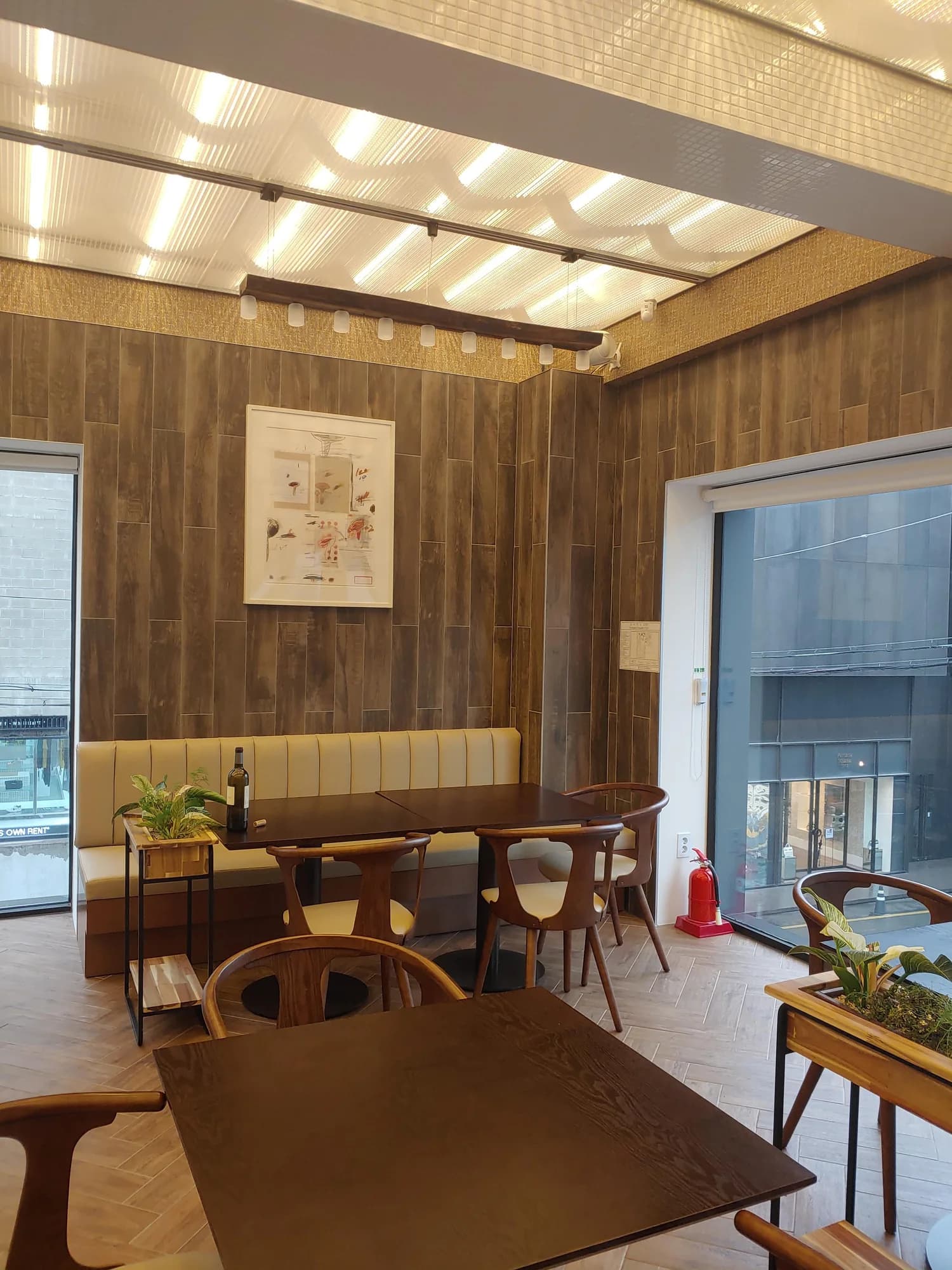
Not every restaurant has a button. Look on the tabletop edge and side before assuming one is missing; it may sit near the tissue box or under a corner.
If there is none, raise a hand slightly and say 저기요 (jeogiyo, “Excuse me/over there”). 여기요 (yeogiyo, “Over here”) is also heard. Speak clearly enough for the room rather than turning it into a shout.
Calling 사장님 (sajangnim, literally “boss/owner”) occurs in casual settings, but visitors do not need to guess anyone’s role. Jeogiyo works without assigning a title.
The Button Does Not Always Place the Order
Some restaurants use a tablet at the table, a kiosk near the entrance, or a QR menu. In those places, the bell may be only for questions and assistance. Other small restaurants take the order verbally with no technology at all.
Read the setup:
- A lit ordering tablet usually handles menu choices.
- A “SELF” sign may direct you to water, utensils or side-dish refills.
- A numbered buzzer may be something you receive after ordering, not something you press.
- A bell labeled 호출 means “call.”
If the screen has no usable language option or rejects payment, the call button is an appropriate way to ask for help.
Paying Usually Happens Somewhere Else
The service bell does not automatically request the bill, and many Korean restaurants expect customers to pay at the front counter. Look for a register near the exit and bring the table number or order slip if one was provided.
At a table-payment venue, staff will tell you or bring the terminal. Do not leave cash beside the call button and assume the meal is settled.
The cultural surprise is not the technology; it is the rhythm. In many countries, good service means constant checking. Here, a tiny button can mean the opposite kind of courtesy: your table gets privacy until it makes one clear, cheerful ding-dong.