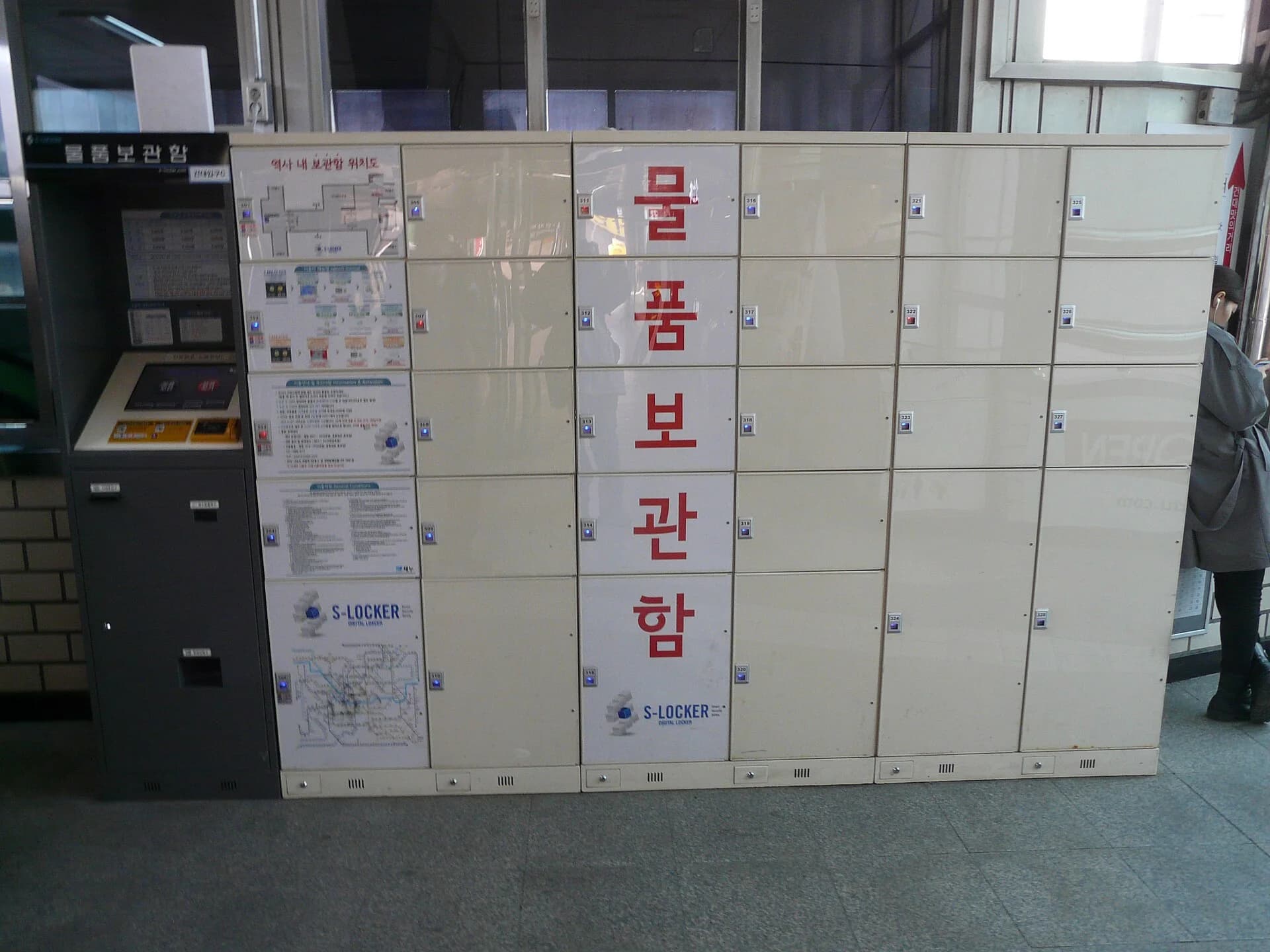
The suitcase fits. The door clicks. You celebrate—then realize you do not remember which underground corridor you are standing in.
Seoul’s subway storage is genuinely useful, but “the locker at Seoul Station” is not a complete location. A major station can have multiple operators, levels, exits and locker banks. The smart move happens before the door closes: identify the service, photograph the location and note the retrieval deadline.
First, Choose Among T-Locker, T-Luggage and T-Storage
The names are similar because they belong to the same storage family, but they solve different problems.
T-Locker is hourly self-service storage in subway stations. T-Luggage uses staffed station centres for luggage storage and same-day delivery options. T-Storage is monthly storage rather than a tourist’s afternoon locker.
If you only need to walk around bag-free until check-in, T-Locker is the likely match. For an oversized case, station-to-airport delivery or staff assistance, compare T-Luggage instead. Do not start a monthly T-Storage flow because its name sounded generic.
Check the Station Before You Drag the Suitcase There
Seoul’s official page currently lists 5,557 T-Lockers at 273 stations. That is broad coverage, not a promise that the nearest bank has an empty large compartment.
The listed internal dimensions are 50 × 30 × 60 centimetres for small, 50 × 45 × 60 for medium and 50 × 90 × 60 for large. Measure the hard shell, wheels and handles—not the airline label—if the fit is close.
Newer lockers use the Korean-language T-Locker app for availability, payment, storage and retrieval. Older banks may use their own on-site instructions. Because interfaces change, check the actual locker before assuming that a travel blog’s screenshots still match.
The Clock Keeps Running After Four Hours
As checked on September 3, 2026, Seoul’s official guide gives T-Locker a four-hour base period. Weekday base prices are listed as ₩2,200 small, ₩3,300 medium and ₩4,400 large; weekend prices are ₩3,100, ₩4,600 and ₩6,100. Extra hourly charges then apply by size.
Treat those numbers as a dated planning reference, not a permanent fare card. Confirm the amount on the live screen or official page before paying.
The important calculation is the retrieval time. A cheap base period can become a longer charge when lunch turns into shopping, shopping turns into dinner and nobody checks the countdown.
Closing Time Can Lock You Out
T-Locker’s official operating window is currently 5 AM to midnight, including weekends and holidays. Storage and retrieval are unavailable outside those hours.
That makes “24-hour subway station” a dangerous assumption. A station entrance may be physically visible while the paid area, corridor or locker service is closed. If your airport train, intercity bus or KTX departure leaves near the edge of operating hours, build in a generous margin.
T-Luggage centres have their own staffed hours, often different from the hourly lockers. Check the exact location page for the service you chose.
Photograph the Locker Location, Not Just the Door
Save four things before walking away:
- The station, line and operator area.
- The floor and nearest exit number.
- The locker bank and compartment number.
- The receipt, QR code, password or app reservation used for retrieval.
Do not include a visible password in a photo you may post publicly. Keep valuables, passports, medicines, animals, plants, dangerous items and anything prohibited by the posted terms out of the locker. Seoul’s page also notes limited compensation for company-caused damage, so a locker is not a substitute for travel insurance or personal custody of irreplaceable items.
If the system fails, use the contact number shown on that locker. The city lists Korean-language support and says on-site assistance can involve a fee for user-caused problems.
The best Seoul locker experience is uneventful: a bag disappears for a few hours and reappears exactly when needed. One location photo and one alarm on your phone do most of the work.